Tax Clearance Certificate Philippines 2026: BIR Guide & Fees
Need a Tax Clearance Certificate in the Philippines but unsure about the requirements, fees, or application process? Whether you are applying for government bidding, a business transaction, a bank loan, accreditation, or another official purpose, preparing the correct documents can save you from delays and rejected applications. Unlike a police clearance, which verifies criminal records, a BIR Tax Clearance Certificate confirms that a taxpayer has met the applicable tax compliance requirements.
This 2026 guide explains how to get a BIR Tax Clearance Certificate, including the latest requirements, application steps, processing time, fees, validity, online options, and common reasons applications are delayed. It also explains the differences between TCGP, TCVC, and TCBP so you can apply for the correct certificate the first time.
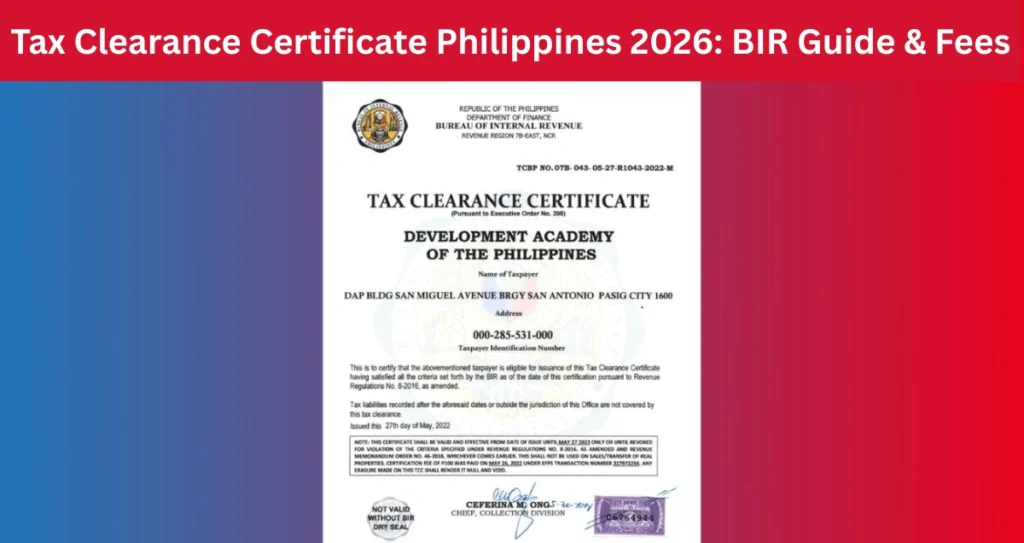
What Is a Tax Clearance Certificate?
A Tax Clearance Certificate, or TCC, is issued by the Bureau of Internal Revenue to confirm a taxpayer’s compliance status.
Depending on the certificate, it may confirm that the taxpayer:
A TCC may be issued to individuals, professionals, sole proprietors, partnerships, corporations, cooperatives, associations, and joint ventures.
Tax Clearance, Tax Clearance Certificate, and BIR Clearance
These terms are commonly used for the same document, but they have slightly different meanings:
Always ask the requesting organization which specific certificate it requires.
Types of Tax Clearance in the Philippines
The correct clearance depends on its intended purpose.
Tax Clearance for General Purposes
The Tax Clearance for General Purposes, or TCGP, confirms that a taxpayer has satisfied the tax-compliance requirements for an approved general transaction.
It may be used for:
The appropriate Regional Collection Division normally processes the final TCGP application.
Tax Clearance for Bidding Purposes
The Tax Clearance for Bidding Purposes, or TCBP, is required from taxpayers participating in certain government procurement activities.
Most non-large taxpayers must first obtain a Tax Compliance Verification Certificate from their registered RDO.
Tax Compliance Verification Certificate
The Tax Compliance Verification Certificate, or TCVC, confirms that a non-large taxpayer meets the tax-compliance conditions required before applying for a TCBP.
It is obtained from the Collection Section of the taxpayer’s registered Revenue District Office.
Individual Tax Clearance
This refers to a clearance issued to an employee, freelancer, professional, sole proprietor, or another individual taxpayer.
The actual certificate may be a TCGP, TCVC, or TCBP, depending on its purpose.
Business Tax Clearance
A business tax clearance may be obtained by a sole proprietorship, partnership, corporation, cooperative, association, or joint venture.
Businesses commonly need it for government bidding, accreditation, bank loans, and regulatory transactions.
Tax Clearance for Final Settlement of Government Contracts
A contractor may need this specialized clearance before receiving the final settlement or payment under a government contract.
It is different from the tax clearance used during the bidding stage.
Other Specialized BIR Clearances
Separate BIR clearances or certifications may apply to:
A general-purpose clearance should not be used when a specialized certificate is required.
Purpose of a Tax Clearance Certificate
A Tax Clearance Certificate may be requested for the following transactions.
Government Bidding and Contracts
Businesses and individuals may need a TCBP to qualify for government procurement projects.
A separate clearance may be required before receiving the final payment under a completed government contract.
Loan Applications
Banks may request a TCGP to assess whether the applicant has unresolved tax liabilities.
Other documents such as income tax returns, financial statements, bank records, and proof of income may also be required.
Accreditation and Licensing
A tax clearance may be requested for accreditation or licensing by government agencies and regulated institutions.
Examples include PhilGEPS, PEZA, PPA, PCAB, SEC, BSP, PRC, and other public offices.
Franchise and Permit Renewal
The TCGP may be required for LTFRB franchise renewal.
Some local governments or regulators may also request it for permit or license renewal, but it is not automatically required for every business permit.
Employment and Government Promotion
A tax clearance may be requested for certain government appointments, confirmations, or promotions.
It is not a standard requirement for every private-sector job.
Collection and Financial Transactions
Organizations may require a tax clearance for collection, payment, accreditation, or financial verification purposes.
Real-Property or Stock Transactions
The sale or transfer of real property and shares normally follows separate BIR tax procedures.
A general TCGP should not replace the specific certificates required for these transactions.
Eligibility Criteria for a Tax Clearance Certificate
To qualify, the taxpayer should generally have:
Any unresolved tax issue should be corrected before applying.
Tax Clearance Requirements for 2026
Requirements depend on the certificate type, taxpayer classification, and application purpose.
Requirements for a Tax Clearance for General Purposes
The following documents are commonly required for a TCGP.
General Requirements
- Accomplished and notarized application form
- Valid government-issued ID
- Three specimen signatures
- Proof of certification-fee payment
- Required documentary stamp
- Original Delinquency Verification Report
- Authorization documents, when applicable
For an Individual Applying Through a Representative
Prepare:
- Special Power of Attorney
- Valid ID of the taxpayer
- Valid ID of the representative
- Three specimen signatures from both persons
An SPA is normally unnecessary when the taxpayer personally applies and claims the certificate.
For a Corporation
Prepare:
- Secretary’s Certificate or Board Resolution
- Latest SEC-received General Information Sheet
- Valid IDs of the authorized persons
- Three specimen signatures
For a One Person Corporation
Prepare:
- Latest SEC-received General Information Sheet
- Special Power of Attorney, when represented
- Valid IDs and specimen signatures
For a Partnership
Prepare either:
- Partnership Certificate or Resolution, or
- Articles of Partnership
For a Cooperative
The BIR may request:
- Cooperative Annual Progress Report
- Cooperative Assessment Information System record
- Articles of Cooperation
- Cooperative Secretary’s Certificate or Resolution
- Certificate of Compliance or Eligibility
For a Joint Venture
Prepare:
- Signed Joint Venture Agreement
- Authorization document for each party
- General Information Sheet of each corporate participant
Requirements for a Tax Compliance Verification Certificate
A manual TCVC application commonly requires:
Electronic applicants should upload clear scanned copies of the same documents.
Requirements for a Tax Clearance for Bidding Purposes
The standard requirements may include:
Other Documents That May Be Requested
The BIR or requesting organization may ask for additional documents.
For Individuals
- Tax Identification Number
- Latest Income Tax Return
- Certificate of Employment
- Community Tax Certificate
- Proof of income
- BIR registration records
For Businesses
- BIR Certificate of Registration
- Mayor’s or business permit
- Audited financial statements
- Previous income tax returns
- SEC, DTI, CDA, or partnership documents
- Proof of tax payments
- BIR Form 0605, when applicable
For Bidding or Accreditation
- Application letter
- PhilGEPS registration details
- Previous tax clearance
- Authorization letter
- Accreditation documents
- Government contract information
These are not universal requirements. Follow the checklist for your specific certificate.
Which Application Form Should You Use?
Use the form that matches your taxpayer classification and clearance purpose.
Available forms may include:
Do not rely on one general form for every tax-clearance transaction.
How to Get a Tax Clearance Certificate Step by Step
Step 1: Ask the Requesting Institution for the Exact Certificate
Confirm whether you need a:
This prevents you from applying for the wrong document.
Step 2: Confirm Your Registered RDO
Verify the RDO where your TIN is registered.
Check that your name, TIN, address, contact details, and taxpayer classification are correct.
Step 3: Review Your Tax Compliance
Check for:
Correct these issues before submitting the application.
Step 4: Secure the Prerequisite Certificate
For a TCGP, secure the required Delinquency Verification Report.
For a TCBP, most non-large taxpayers must first obtain a TCVC from their registered RDO.
Step 5: Complete the Correct Application Form
Enter your:
Have the form notarized when required.
Step 6: Prepare Supporting Documents
Arrange documents according to the official checklist.
Bring originals and photocopies for manual submission, or upload clear and complete scans for an online application.
Step 7: Pay the Required Fees
Payments may be made through authorized BIR channels, banks, online payment facilities, or the option provided in eTCS.
Keep the receipt or electronic payment confirmation.
Step 8: Submit the Application
Submit to the correct office:
Step 9: Wait for Verification
The BIR may check:
Incomplete applications may be returned for correction.
Step 10: Claim or Download the Certificate
For manual applications, present the claim stub and valid ID.
For online applications, the approved certificate may be downloaded through the electronic system.
Confirm whether the receiving institution accepts a digital copy or requires the original document.
Tax Clearance Certificate Online Application
Covered taxpayers may apply through the Electronic Tax Clearance System.
The system may allow users to:
The eTCS may cover TCGP, TCVC, TCBP, and Delinquency Verification Report applications.
Availability may depend on the taxpayer’s registered revenue region.
Is eBIRForms the Tax Clearance Application Portal?
No.
eBIRForms is mainly used for preparing and filing certain tax forms, while eFPS supports electronic tax filing and payment.
The dedicated platform for covered tax-clearance applications is eTCS.
Tax Clearance Processing Time
Processing time depends on the certificate type and document completeness.
Tax Clearance for General Purposes
A complete TCGP application may have a standard processing time of approximately:
Delays may occur when verification or document correction is needed.
Tax Clearance for Bidding Purposes
A complete TCBP application may have a standard processing time of approximately:
Tax Compliance Verification Certificate
A manual TCVC application may take approximately:
Why Some Guides Say Three to Seven Working Days
Actual release may take three to seven working days when:
Apply early to avoid transaction delays.
Tax Clearance Certificate Fees
The standard charges commonly include:
| Fee | Amount |
|---|---|
| Certification fee | ₱100 |
| Documentary stamp | ₱30 |
| Common total | ₱130 |
Other possible expenses include:
Confirm the total before making payment.
Tax Clearance Validity
Validity depends on the type of certificate.
TCBP Validity
A Tax Clearance for Bidding Purposes is generally valid for one year from the date of issuance unless revoked earlier.
TCVC Validity
A Tax Compliance Verification Certificate is generally valid for 90 days from the date of issuance.
It should be used before it expires when applying for a TCBP.
TCGP Validity
There is no single validity period for every TCGP.
Follow:
- The validity shown on the certificate
- Instructions from the issuing BIR office
- The recency requirement of the requesting organization
Renewal or New Application
An expired clearance is not simply extended.
The taxpayer normally files a new or renewal application so the BIR can verify the current tax status.
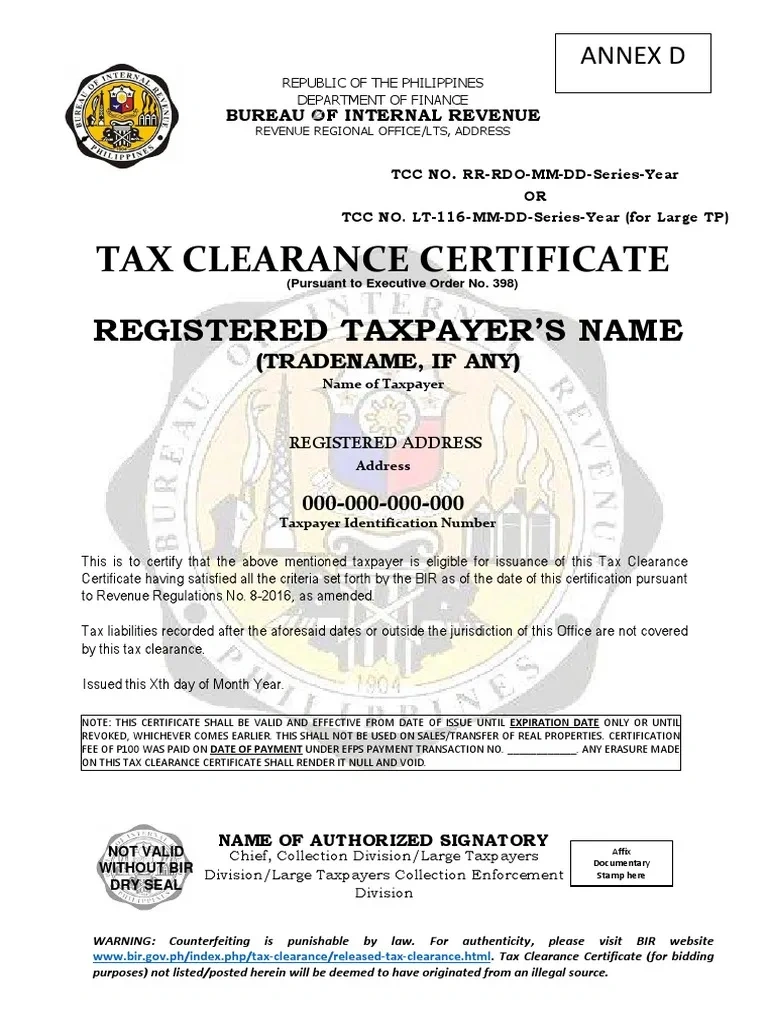
Tax Clearance Certificate Sample and Format
The certificate format may vary, but it commonly shows:
Common Reasons for Delay or Rejection
Unpaid Tax Liabilities
Outstanding taxes, penalties, interest, or surcharges may prevent approval.
Unfiled Tax Returns
Missing required returns may create a stop-filer case and delay the application.
Mismatched TIN or Registered Name
Differences between BIR records, IDs, and business documents must be corrected.
Incomplete Requirements
Missing IDs, signatures, payment receipts, documentary stamps, authority documents, DVRs, or TCVCs may cause rejection.
Wrong Application Form
Using a form for the wrong taxpayer type or purpose may result in the application being returned.
Wrong Processing Office
Submitting to the wrong RDO, regional office, or Large Taxpayers office can cause delays.
Pending Audit or Assessment
An unresolved assessment or tax liability resulting from an audit may affect approval.
Stop-Filer Status
A stop-filer status means the BIR expects one or more tax returns that are missing from its records.
Cannot-Be-Located Status
The taxpayer may need to update or confirm the registered address before approval.
Pending Tax-Related Case
A disqualifying tax-related case may prevent the certificate from being issued.
Outdated Business Documents
Expired IDs, old GIS records, outdated permits, or invalid authority documents may not be accepted.
Unreadable Electronic Files
Blurred, cropped, incomplete, or password-protected files may be returned.
System or Verification Delays
BIR system issues, high application volume, or manual record checks may extend processing.
Tips for a Smooth Application
BIR Contact Information
For assistance, contact:
You may also contact your registered RDO for guidance on requirements, tax records, and processing jurisdiction.
Frequently Asked Questions
Final words
A Tax Clearance Certificate is an important document that confirms an individual or business has complied with the Bureau of Internal Revenue requirements for a specific transaction.
To avoid delays, rejection, or repeated visits, applicants should first identify the correct type of certificate, verify their registered Revenue District Office, submit any missing tax returns, settle outstanding tax liabilities, and prepare all required supporting documents.
Applying through the correct BIR office and using the proper form can make the Tax Clearance Certificate application process faster, smoother, and more successful.