Chief of Philippine National Police Role Powers Appoint 2026
The Chief of the Philippine National Police (PNP), also known as the Hepe ng Pambansang Pulisya ng Pilipinas, is the highest-ranking official in the country’s law enforcement system. This position is responsible for leading the entire national police force, maintaining peace and order, and ensuring public safety across the Philippines, including the proper implementation of systems like police clearance services that support background verification and public trust.
As the top commander, the Chief of the Philippine National Police directly influences crime prevention strategies, national security operations, and the overall effectiveness of policing in the country.

Key Responsibilities of the PNP Chief
Operational Oversight
Leads and supervises all police operations across the Philippines to ensure law and order.
Administrative Leadership
Manages personnel, promotions, discipline, and resources within the organization.
Public Safety Enforcement
Implements strategies that protect citizens, reduce crime, and strengthen national security.
Strategic Command
Ensures all regional and local police units follow unified national law enforcement goals.

Role of the Chief of Philippine National Police Explained
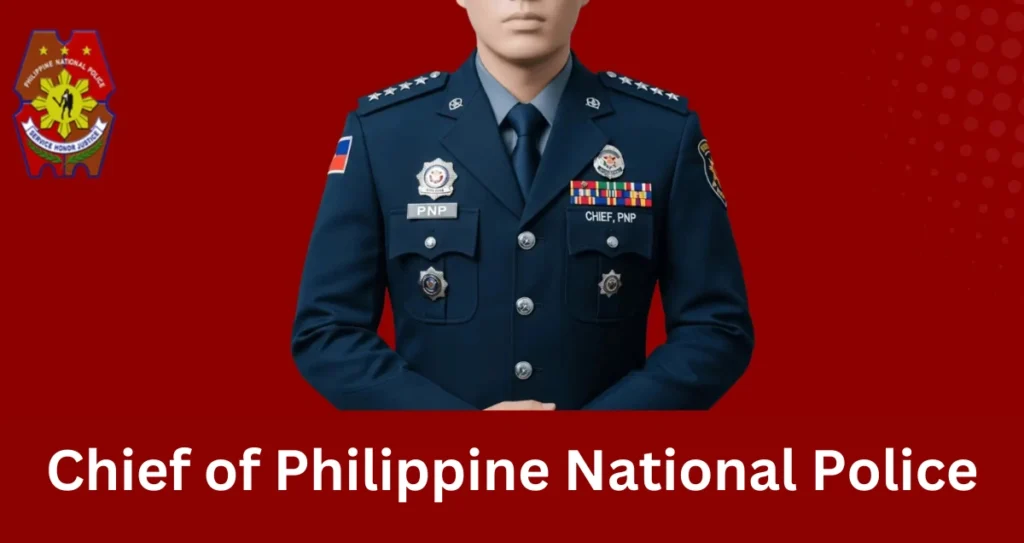
The Chief of Philippine National Police holds the rank of Police General, the highest rank in the organization. This role serves as the central command authority for all policing activities in the country.
Main duties include:
The PNP Chief also sits as an ex officio member of the National Police Commission (NAPOLCOM), which governs policy and organizational oversight.
How to Become the PNP Chief (Step-by-Step)
Step 1: Attain senior officer rank (at least Police Brigadier General)
Step 2: Build a distinguished service record within the PNP
Step 3: Avoid being within 6 months of mandatory retirement
Step 4: Get shortlisted by the National Police Commission (NAPOLCOM)
Step 5: Receive official appointment from the President of the Philippines
Important: No confirmation from the Commission on Appointments is required.
Powers and Authority of the PNP Chief
The PNP Chief has broad command authority under Republic Act No. 6975, including:
Full Command Control
Direct authority over all PNP units nationwide
Policy Execution Power
Can issue operational guidelines and national directives
Operational Deployment
Controls movement and assignment of police personnel
Delegation Authority
Can assign responsibilities to subordinate officers
Organizational Control
Manages resources, training, and strategic priorities
Term of Office and Legal Basis
The Chief of Philippine National Police serves a fixed term of 4 years under Republic Act No. 6975.
However, the President may extend the term in cases of:
This ensures leadership stability during critical periods.
PNP Command Group and Structure
The PNP Chief is supported by a high-level command structure:
Deputy Chief for Administration
Handles personnel, logistics, and internal affairs
Deputy Chief for Operations
Oversees field operations and tactical missions
Chief of the Directorial Staff
Coordinates planning and organizational strategy
This structure ensures smooth execution of national policing operations.
Complete List of PNP Chiefs (Past and Present)
| No. | Rank | Name | Term |
|---|---|---|---|
| 1 | Police Director General | Cesar P. Nazareno | 1991–1992 |
| 2 | Police Director General | Raul S. Imperial | 1992–1993 |
| 3 | Police Director General | Umberto A. Rodriguez | 1993–1994 |
| 4 | Police Director General | Recaredo A. Sarmiento II | 1994–1997 |
| 5 | Police Director General | Santiago Aliño | 1997–1998 |
| 6 | Police Deputy Director General | Roberto Lastimoso | 1998–1999 |
| 7 | Police Director General | Panfilo M. Lacson | 1999–2001 |
| 8 | Police Director General | Oscar C. Calderon | 2006–2007 |
| 9 | Police Director General | Jesus Ame Versoza | 2008–2010 |
| 10 | Police Director General | Alan LM Purisima | 2012–2015 |
| 11 | Police General | Ronald “Bato” Dela Rosa | 2016–2018 |
| 12 | Police General | Debold M. Sinas | 2020–2021 |
| 13 | Police General | Guillermo Lorenzo T. Eleazar | 2021 |
| 14 | Police General | Benjamin C. Acorda Jr. | 2023–2024 |
| 15 | Police General | Rommel Francisco Marbil | 2024–2025 |
| 16 | Police General | Nicolas Torre | 2025 |
| 17 | Acting Police Lt. Gen. | Jose Melencio Nartatez | 2025–Present |
Why This Position Is So Important (High Impact Section)
The Chief of the PNP is one of the most powerful security positions in the Philippines because it directly impacts national safety and stability.
Key reasons include:
In short, the PNP Chief shapes how safe the country is at any given time.
Salary and Benefits of the PNP Chief (2026 Update)
Salary Structure (Overview Table):
| Component | Details |
|---|---|
| Base Salary | Based on Police General rank (highest PNP rank) |
| Hazard Pay | Given due to high-risk duties |
| Longevity Pay | Additional pay for years of service |
| Allowances | Housing, clothing, and operational allowances |
| Other Benefits | Security detail, transport support, official privileges |
Key Benefits
Eligibility Requirements to Become PNP Chief
Basic Requirements (Step-by-Step)
Important Criteria Checklist
Challenges Faced by the PNP Chief in Modern Law Enforcement
Major Challenges (List Format)
Operational Difficulties
Frequently Asked Questions
Final words
The Chief of the Philippine National Police is the highest authority in the country’s law enforcement system. From commanding nationwide police operations to shaping national security strategies, this role is essential for maintaining peace, order, and public safety.
With rising security challenges, the leadership of the PNP Chief remains a key pillar in protecting the nation and ensuring stable governance.