Police Clearance Fee in the Philippines: Complete 2026 Guide
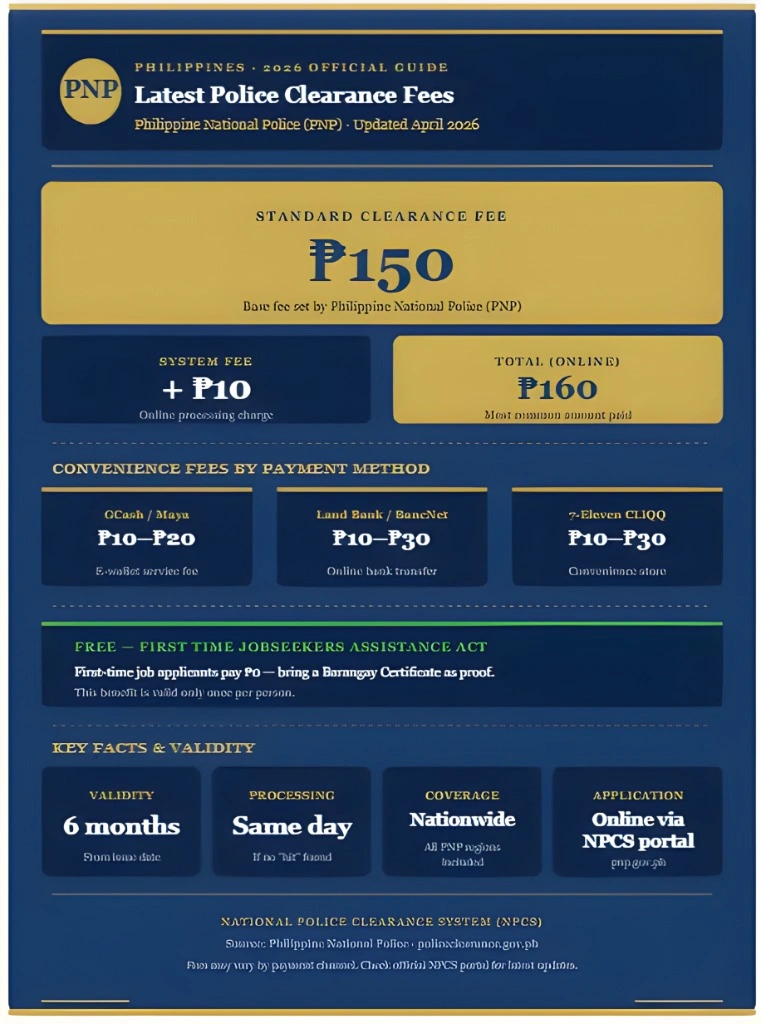
The official National Police Clearance fee in the Philippines is ₱150. However, the amount shown at checkout may be higher because the payment provider can add a convenience or transaction fee.
Most applicants should therefore prepare approximately ₱150 to ₱180 for an online National Police Clearance application. The final amount depends on the payment method available through the National Police Clearance System, or NPCS. Separate local documents, transportation, photocopying, work permits, or municipal charges may increase the applicant’s total expenses, but they are not automatically part of the national police clearance fee.
This guide explains the official fee, possible additional costs, online payment methods, application requirements, local and national clearance differences, first-time jobseeker exemption, processing steps, validity, renewal, and common payment problems.
Police Clearance Fee in the Philippines at a Glance
| Cost or service | Expected amount | Important details |
|---|---|---|
| National Police Clearance base fee | ₱150 | Official NPCS application fee |
| Online payment charge | Varies | Displayed before payment confirmation |
| Common estimated online total | Around ₱150–₱180 | Depends on the payment channel |
| Local Police Clearance | Varies by LGU | Controlled by the city or municipality |
| First-time jobseeker clearance | Free when qualified | Barangay certification is required |
| Renewal or new application after expiry | ₱150 plus applicable payment fee | Processed as another clearance application |
| Barangay clearance, cedula or work-permit expenses | Varies | Only required when requested separately |
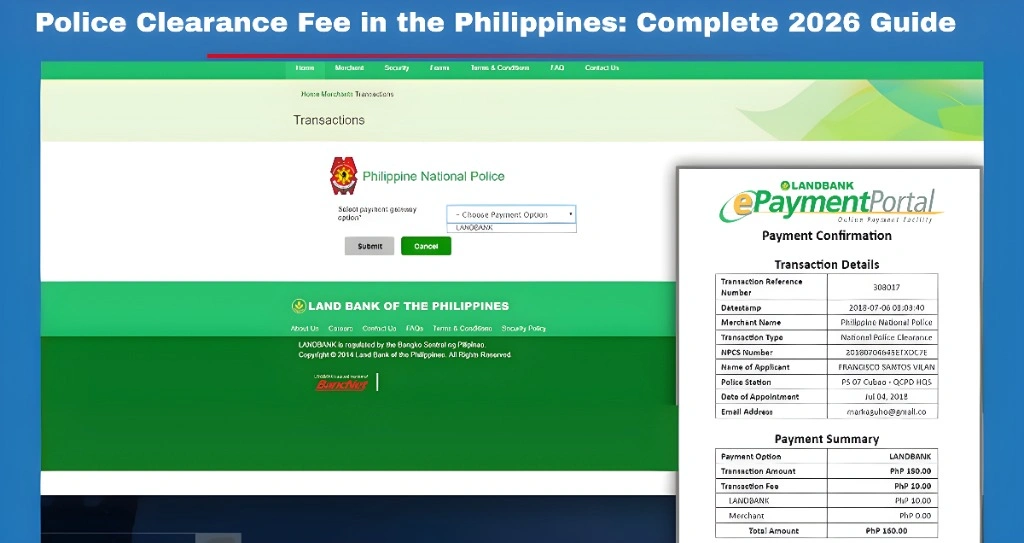
The PNP application tutorial confirms that the clearance itself costs ₱150 and that an additional convenience fee may depend on the selected payment mode.
Official National Police Clearance Fee for 2026
The official National Police Clearance application fee remains ₱150. This payment covers the processing of the application through the NPCS, identity and record verification, biometric registration, and issuance of the clearance certificate.
A payment-channel fee may be added when the applicant pays through an e-wallet, bank, payment card, QR service, or over-the-counter collection partner. The amount is not identical for every applicant because the available channels and charges can change.
LANDBANK confirms that Link.BizPortal supports several payment methods, including LANDBANK and OFBank accounts, participating BancNet banks, e-wallets, and eligible credit, debit, and prepaid cards.
How Much Do Applicants Actually Pay?
For a straightforward online application, the total is generally calculated as:
| Charge | Estimated amount |
|---|---|
| NPCS fee | ₱150 |
| Payment-provider fee | Amount displayed at checkout |
| Estimated total | Usually around ₱150–₱180 |
Older published Link.BizPortal schedules listed payment charges ranging from approximately ₱15 to ₱30 for several common channels. Current charges may be different, and some government-payment channels may temporarily waive transaction fees. Applicants should rely on the amount displayed during the actual NPCS checkout process.
The applicant’s overall expenses may be higher when the process also involves:
These are related expenses rather than a higher national police clearance fee.
National Police Clearance vs Local Police Clearance
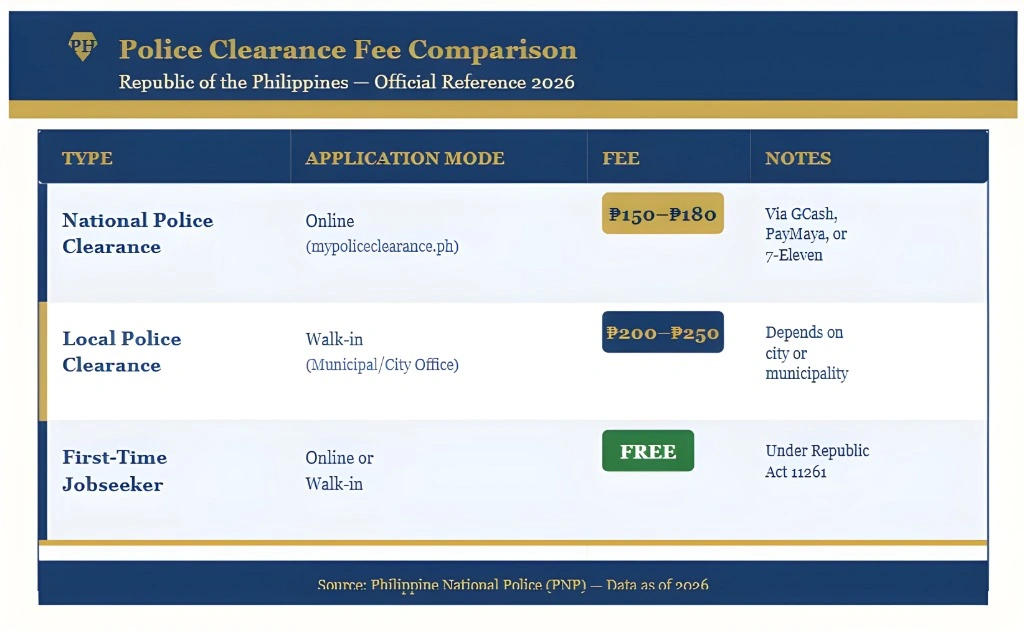
National and local police clearances serve different purposes. Applicants should confirm which document their employer, school, licensing authority, visa office, or government agency requires.
| Feature | National Police Clearance | Local Police Clearance |
|---|---|---|
| Issuing system | PNP National Police Clearance System | City or municipal police office |
| Base fee | ₱150 plus payment-channel fee | Determined by the LGU |
| Coverage | Nationwide PNP record verification | Local records or locally defined checks |
| Application method | Online registration and appointment | Depends on the city or municipality |
| Payment method | NPCS-supported online channels | Local cashier, treasurer or municipal payment system |
| Common use | Employment, government transactions and nationwide requirements | Local employment, permits or municipal requirements |
| Biometrics | Captured at the selected police station | Depends on local procedure |
| Validity | Commonly six months | Depends on the issuing office |
A National Police Clearance uses the centralized PNP system and is intended for nationwide use. A Local Police Clearance is governed by local procedures and may carry different requirements or charges.
Police Clearance Fee by City
The ₱150 NPCS fee applies to a National Police Clearance regardless of the city in which the applicant completes biometric capture. However, local police clearances, work permits, barangay documents and municipal certificates may have separate charges.
There is no single verified national table establishing one total Local Police Clearance price for every city in 2026.
| City or area | National NPCS base fee | Local or separate charges | What applicants should do |
|---|---|---|---|
| Makati | ₱150 | May depend on the local service or permit being requested | Contact the Makati Police Department or relevant city office |
| Pasig | ₱150 | Local charges are not part of one national fee schedule | Confirm with the selected station or Pasig City office |
| Manila | ₱150 | Barangay, permit or municipal requirements may be separate | Check the exact document required before paying |
| Quezon City | ₱150 | Occupational and city-permit fees may be separately assessed | Use the relevant QC service guide or contact the office |
| Provincial cities and municipalities | ₱150 | Local fees and requirements differ by LGU | Confirm with the municipal or city police station |
Official city documents show that LGUs may operate separate clearance, certification and occupational-permit processes. These should not be confused with the standard NPCS fee.
Important Warning About Unverified City Fee Tables
Some online articles quote the following totals:
| Area | Frequently quoted online estimate | Verification status |
|---|---|---|
| Makati | ₱750–₱800 | Not confirmed as the standard NPCS fee |
| Pasig | Around ₱270 | Not confirmed by one current official national schedule |
| Manila | Around ₱250 | May combine barangay or local requirements |
| Quezon City | Around ₱180 | May reflect the ₱150 fee plus a payment charge |
| Provincial areas | Around ₱150–₱250 | Depends on the LGU and application type |
These numbers should not be presented as guaranteed police clearance prices. A high total may combine the police clearance with a barangay clearance, cedula, occupational permit, identification card or another city service.
Applicants should ask for an official order of payment or receipt showing what each charge covers.
How to Apply for a National Police Clearance Online
The NPCS allows applicants to create an account, complete their information, choose a station, schedule an appointment and pay online. Personal appearance is still required for identity verification and biometric capture.
Step 1: Open the Official NPCS Portal
Use the official PNP National Police Clearance System.
Avoid websites that imitate the government portal, charge assistance fees, or promise a clearance without personal verification. The legitimate NPCS domain is pnpclearance.ph.
Step 2: Register for an Account
Select the registration option and provide the requested information, including:
Complete any email verification step before attempting to sign in.
Step 3: Complete and Review Your Profile
Enter the information exactly as it appears on your valid government-issued identification.
Check the spelling of your:
An incorrect name or birth date can cause a delay during station verification.
Step 4: Select a Police Station
Choose the police station where you will personally appear for biometric capture and processing.
Consider:
The official PNP process requires applicants to select a station and an available schedule.
Step 5: Choose an Appointment Date
Select an available appointment date and session. Depending on the station, the available choices may be divided into morning and afternoon schedules.
Review the date carefully before proceeding to payment.
Step 6: Generate the Payment Reference
After confirming the appointment information, continue to the payment section. The system will generate the transaction or reference details needed to identify your application.
Save the following:
Step 7: Select a Payment Method
The payment page will display the channels currently available for that transaction.
Possible options may include:
Not every option will necessarily appear for every application. Use only the channels displayed by the official payment page.
Step 8: Pay and Save the Receipt
Complete the payment and save:
Do not pay the same transaction twice if the status does not update immediately.
Step 9: Check the Payment Status
Return to the NPCS account and review the transaction status.
A successful payment should eventually be reflected in the dashboard. Processing time may depend on the bank, e-wallet, collection outlet or payment gateway.
Step 10: Visit the Selected Police Station
Bring:
The current PNP tutorial lists one valid government-issued ID, proof of payment and the NPC appointment reference among the required items. An older PNP guide mentions two valid IDs, so bringing two original IDs can help avoid difficulties.
Step 11: Complete Biometric Capture
At the station, the applicant may undergo:
Follow the instructions of the clearance personnel and make sure the printed details are correct.
Step 12: Record Verification and Release
The application is checked against the PNP database.
When no possible matching record requires clarification, the clearance may be released after normal verification. When the system identifies a possible record match, additional checking may be necessary before the certificate is issued.
A possible match does not automatically mean that the applicant has a criminal record. It can also occur when another person has similar identifying information.
Step 13: Download or Print the Certificate
The NPCS includes a clearance-verification function, and approved applicants using the applicable certification process may download their clearance from their account. Keep both a printed copy and a secure digital copy.
Police Clearance Requirements
Applicants should prepare the following:
The ID should be original, unexpired, readable and consistent with the name entered in the NPCS account.
Common government-issued IDs may include:
Applicants should confirm station requirements when their identification has expired, contains a different surname, or does not show a clear photograph or signature.
Police Clearance Payment Options
1. LANDBANK or OFBank
Applicants with a supported LANDBANK or OFBank account may pay through the Link.BizPortal option displayed during checkout.
This is a direct government-payment channel, although a fee may apply unless the transaction qualifies for a current fee waiver.
2. GCash
GCash may appear as an e-wallet option through the payment gateway.
Applicants should confirm that:
3. Maya and Other E-Wallets
Maya or another e-wallet may be available through a partner gateway. Availability can change, so applicants should rely on the choices shown during checkout rather than assuming that a specific wallet will always be available.
4. Credit, Debit or Prepaid Card
Link.BizPortal supports eligible cards bearing brands such as Visa, Mastercard and JCB.
This option may be useful for applicants who do not have a supported local bank account or e-wallet.
5. BancNet Online Banking
Applicants with an account at a participating BancNet member bank may be able to pay through online banking.
The applicant must follow the bank-authentication steps and wait for the successful-payment page before closing the browser.
6. QRPh
QRPh may be offered for certain government payments through Link.BizPortal. LANDBANK announced waived transaction fees for selected government payments through certain QRPh and LANDBANK or OFBank channels from June 1 to December 31, 2026.
The actual NPCS payment page will determine whether the transaction qualifies.
7. 7-Eleven and Other Cash Outlets
A cash-payment option may direct the applicant to an authorized collection partner such as:
Generate the payment instructions first, pay before the deadline and keep the printed receipt.
8. PCHC PayGate and Partner Banks
PCHC PayGate may allow applicants to pay through a participating bank account.
The available banks and fees may change, so check the payment screen before confirming.
9. Other Payment Gateways
Some articles mention Dragonpay, Coins.ph and similar gateways. These should only be used when they appear inside the official NPCS or authorized LANDBANK payment flow. Applicants should not send money to an account supplied through an unofficial website, message or social-media post.
How to Pay the Police Clearance Fee Through LANDBANK
Link.BizPortal is accessible through the internet and supports payments for participating government and private institutions.
How to Pay the Police Clearance Fee Using GCash
Never send the payment through GCash to a personal mobile number claiming to represent the PNP.
How to Select a Payment Option
The payment method is normally selected after the applicant has:
The applicant should compare the available service fees before confirming payment.
How to Change the Payment Method
When payment has not been completed, the applicant may return to the payment page and check whether another channel can be selected.
When the transaction is already marked successful, do not create a second payment merely to change the channel.
When the amount has been deducted but the NPCS status remains pending:
Free Police Clearance for First-Time Jobseekers
Republic Act No. 11261, known as the First-Time Jobseekers Assistance Act, exempts qualified first-time jobseekers from fees and charges for specified government pre-employment documents, including a police clearance certificate.
Who Is Eligible?
The applicant must generally be:
Required Documents
Applicants should prepare:
The barangay certification must state that the person is a first-time jobseeker and a resident of the issuing barangay.
What Does the Exemption Cover?
The exemption covers the government fee for the police clearance when the applicant qualifies and follows the required procedure.
The benefit is intended to support first-time entry into employment. It should not be treated as a reusable waiver for every future renewal or replacement.
Applicants should notify the police station that they are claiming the exemption and present the original barangay certification before payment or processing.
Express and Same-Day Police Clearance Fees
There is no confirmed nationwide PNP schedule establishing a standard ₱50 to ₱200 express-lane fee for National Police Clearance applications.
Processing speed can depend on:
Applicants should not pay an unofficial “express” or “priority” charge without an official order of payment and receipt.
When the clearance is urgent:
Hidden and Additional Costs
The following expenses are commonly mentioned in online police-clearance guides. They are not fixed national NPCS charges.
| Possible expense | Commonly quoted estimate | When it may apply |
|---|---|---|
| Barangay clearance | ₱50–₱100 | Separate local requirement or first-time jobseeker documentation |
| Cedula or community tax certificate | ₱50–₱70 | When requested by an LGU or related local process |
| Optional local ID printing | ₱150–₱200 | Only where offered or required |
| Photocopying, printing or internet service | ₱10–₱30 or more | Depends on the service provider |
| Transportation | Varies | Travel to and from the selected station |
| Occupational or work permit | Varies by city | Separate from the National Police Clearance |
These figures are estimates rather than an official nationwide price list. Ask which documents are actually required before paying for them.
Refunds, Missed Appointments and Payment Problems
The official public materials reviewed do not establish one detailed nationwide refund and rescheduling rule covering every payment channel and appointment problem.
Applicants should not assume that:
Before paying, verify the station, appointment date, name and transaction amount.
For a payment problem:
Lost Police Clearance and Reissuance
When the certificate is lost:
Keeping a PDF copy, screenshot of the transaction details and printed backup can prevent unnecessary reapplication.
Police Clearance Renewal Fee
An expired Police Clearance is generally replaced through another application rather than extended indefinitely.
A new NPCS application normally requires:
The base application fee is ₱150, with any payment-channel charge shown during checkout. The commonly stated validity period for a National Police Clearance is six months from issuance.
National Police Clearance vs NBI Clearance
A Police Clearance and an NBI Clearance are not identical.
| Feature | National Police Clearance | NBI Clearance |
|---|---|---|
| Issuing agency | Philippine National Police | National Bureau of Investigation |
| Main database | PNP records and police information | NBI national criminal-record database |
| Common purpose | Employment, identification and government requirements | Employment, travel, visa and government requirements |
| Application system | NPCS | NBI clearance system |
| Interchangeable | Only when the receiving organization allows it | Only when the receiving organization allows it |
An employer or government agency may request one document or both. Applicants should obtain the exact document stated in the requirement rather than assuming that one automatically replaces the other.
Can You Walk In for Police Clearance?
A person may contact or visit a local police station for guidance, but the National Police Clearance process is designed around online registration, payment and appointment scheduling.
A local police office may operate a separate walk-in procedure for Local Police Clearance. The fee, requirements and processing method depend on the city or municipality.
To avoid being turned away, applicants should check whether online registration or an appointment is required before visiting.
Can You Get Police Clearance Without a Valid ID?
The official application process requires valid government-issued identification.
A barangay clearance, birth certificate or school ID may support identity verification in some circumstances, but it should not be assumed that these documents automatically replace the required government photo ID.
An applicant without an accepted ID should:
How Overseas Filipinos Can Obtain Police Clearance Certification
The official NPCS portal provides a separate clearance-certification process for categories that include Filipino citizens working or based in another country. Approved applicants under that procedure may download the certificate from their account.
Overseas applicants should:
The normal online appointment process should not be confused with the special certification procedure for applicants who cannot personally visit an ordinary NPCS station.
Tips to Save Money and Avoid Delays
Apply Through the Official System
Using the official NPCS portal reduces the risk of unnecessary assistance fees and fraudulent payments.
Compare the Displayed Payment Charges
Check the convenience fee before confirming the payment. Another available bank, QR or e-wallet option may cost less.
Check for Current Fee Waivers
Certain LANDBANK government-payment channels may temporarily waive transaction fees. Eligibility depends on the channel and transaction displayed at checkout.
Review Your Details Before Payment
Correct errors in the name, date of birth, station and appointment date before paying.
Bring More Than One ID
Although the current tutorial identifies one valid government-issued ID, carrying a second original ID can prevent avoidable delays.
Prepare the Documents Before Travelling
Bring the reference number, payment receipt, identification and any barangay certification required for the fee exemption.
Confirm Separate LGU Requirements
Do not automatically purchase a cedula, barangay clearance or work permit unless the police station, employer or relevant local office requires it.
Confirm Separate LGU Requirements
Do not automatically purchase a cedula, barangay clearance or work permit unless the police station, employer or relevant local office requires it.
Claim the First-Time Jobseeker Exemption
Qualified applicants should obtain the prescribed barangay certification before paying the police clearance fee.
Keep Digital Backups
Save the clearance, payment confirmation, reference number and appointment details in secure cloud storage or email.
Frequently Asked Questions
Final words
The official National Police Clearance fee in the Philippines is ₱150 in 2026. The applicant’s final online payment may be slightly higher because the selected bank, e-wallet, card provider or collection outlet can add a service charge.
Local Police Clearance prices should not be confused with the national NPCS fee. Barangay documents, cedulas, local permits, printing, transportation and optional services may increase the applicant’s overall expenses, but they are not standard nationwide NPCS charges.
The safest approach is to use the official National Police Clearance System, review the full amount before payment, keep the reference number and receipt, bring valid original identification, and verify any additional city requirement directly with the relevant police station or LGU. Qualified first-time jobseekers should secure a barangay certification before paying so they can claim the fee exemption provided by law.