
Police Clearance Sample Philippines: Format & Validity Guide
A Police Clearance Sample Philippines guide helps applicants, employers, and organizations understand what a legitimate Philippine National Police clearance should contain.
You may be checking whether the details on your issued clearance are correct, preparing for an application, or reviewing a document submitted by a job applicant. Whatever the reason, it is important to understand that a police clearance is an official, system-generated document. It is not a form that can be downloaded, edited, and completed manually.
This guide explains the Philippine police clearance format, important certificate sections, verification steps, validity considerations, requirements, uses, police-report differences, and common questions.
What Does a Police Clearance Sample Philippines Document Show?
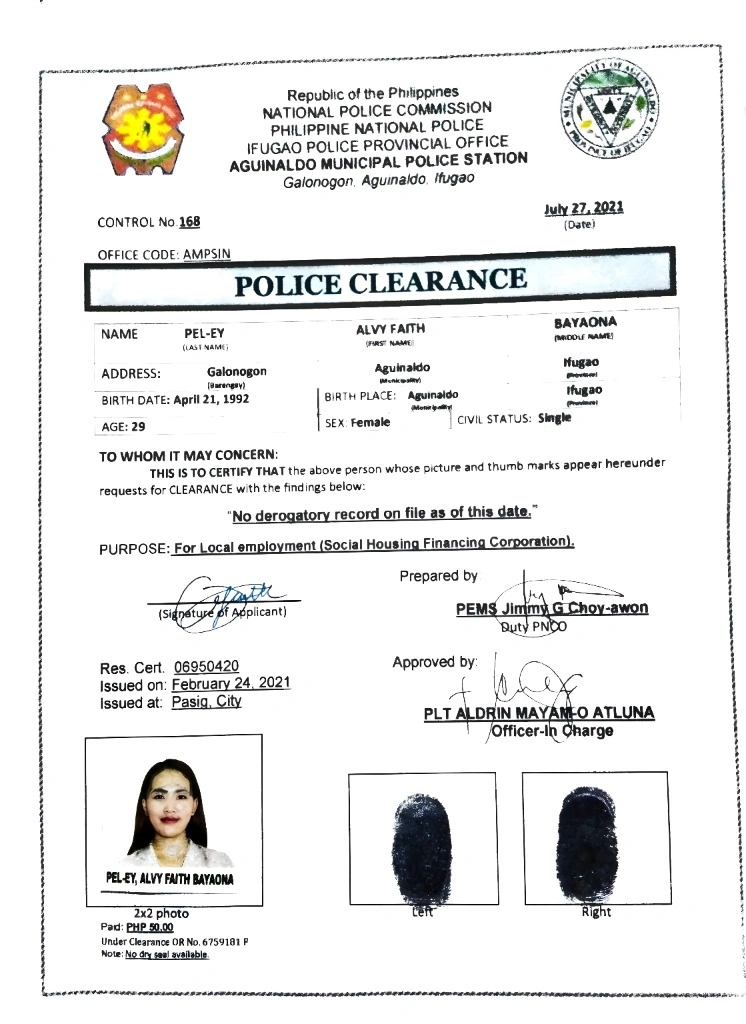
A police clearance sample is an educational visual reference showing the typical information found in a National Police Clearance issued through the Philippine National Police system.
It helps people understand:
Older local police clearances could differ by municipality, police station, typography, paper size, or layout. The National Police Clearance System introduced a more centralized process, but visual placement and design details can still be updated by the issuing authority.
For that reason, official online verification is more reliable than comparing fonts, seals, or screenshots.
A police clearance reflects the result of a records check at the time it is issued. It should not be described as a permanent declaration that a person has never been connected to any incident, investigation, or legal matter.
Philippine Police Clearance Sample Format at a Glance
A Philippine police clearance generally contains several key sections.
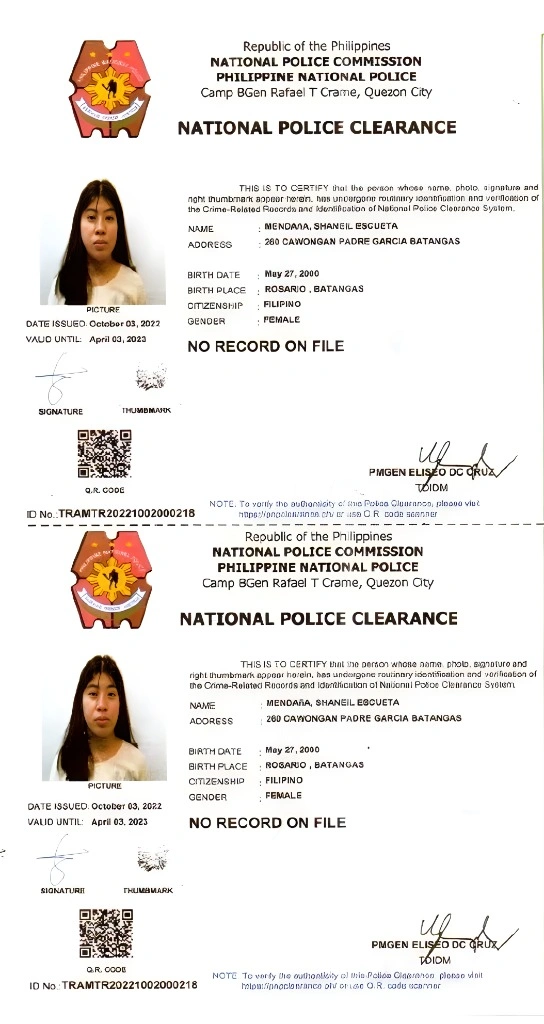
| Certificate Section | Typical Information Included | Why It Matters |
|---|---|---|
| Header | Government and police agency identifiers | Shows the issuing authority |
| Applicant details | Full name and other identifying details | Confirms whose clearance is being reviewed |
| Photo and biometrics | Digitally captured photo and fingerprint information | Supports identity verification |
| Clearance result | Record-check outcome or certification statement | States the status returned by the system |
| Issuance details | Date, issuing officer, station information, and approval details | Connects the clearance to its release process |
| Verification details | Transaction, serial, control, or clearance identification information | Allows official verification |
| QR or machine-readable feature | Scannable or encoded reference element | May support digital verification |
How to Read the Police Clearance Format
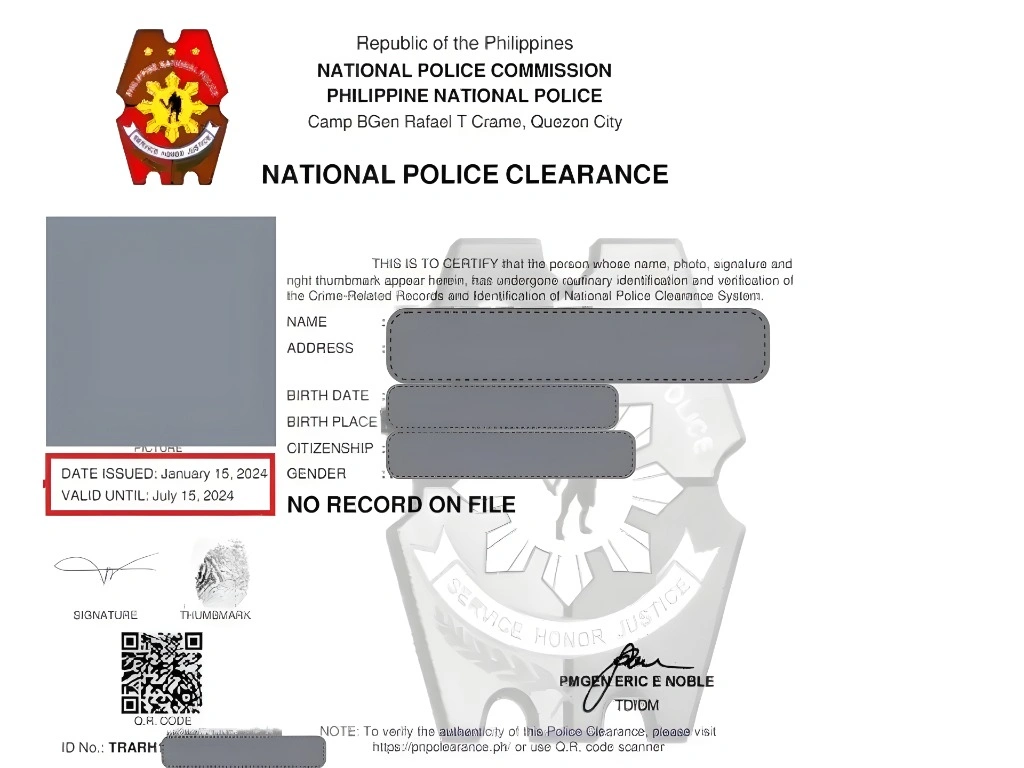
Certificate Header
The top section may include official government and police identifiers, such as:
Some versions may display Department of the Interior and Local Government-related identifiers, the National Police Commission name, and PNP branding.
The exact logo placement should not be the only factor used to decide whether a document is genuine.
Applicant Information
The body of the police clearance normally identifies the applicant.
Information may include:
A purpose may be written as employment, recruitment, travel, professional application, or another transaction-specific reason.
Photo and Biometrics
Modern clearances commonly rely on live identity capture rather than a separately attached 2×2 photograph.
The document or issuance process may involve:
A loose or stapled photo is not a reliable sign of an official system-generated clearance. Applicants should attend the appointment personally because photo and biometric capture are part of the process.
Clearance Statement or Findings
The most important portion of the document is the certification result.
Common wording may include:
A no-derogatory-record result generally means the system did not return a derogatory record for the applicant under the information processed at that time.
A result requiring further checking should not automatically be treated as proof of guilt or a criminal conviction. A possible name match, record hit, or unresolved system result may require identity verification or clarification through the proper PNP process.
Issued By and Approved By
A certificate sample may show official release details, including:
Some examples refer to units such as the Police Examination and Monitoring Section. Titles and signatory details can vary by station and current administrative procedures.
Certificate Footer
The lower part of the document may contain:
A QR code may appear on the lower or side portion of some versions, while other layouts may position it differently. The certificate number and verification data are more important than the exact printed location.
Police Clearance Certificate Sample: Key Information
A police clearance certificate is an official document issued after the applicant completes registration, payment, personal appearance, identity capture, and system checking.
A typical certificate may include:
The certificate is used as evidence that the person completed the police-clearance process and received the result shown in the official system at the time of issuance.
How to Verify a Police Clearance Online
Do not rely only on a printed image, certificate design, watermark appearance, or a photo sent through email or messaging apps.
The safest method is to use the official National Police Clearance System verification process.
Police Clearance Verification Steps
Employers and organizations should not request unnecessary personal information or retain copies longer than needed. Clearance documents contain sensitive identity details and should be handled securely.
Security Features and Authenticity Checks
Some police clearances may contain security-oriented features such as:
These features can help with visual review, but they are not a substitute for official verification. Document layouts can change, physical stamps may differ by office, and screenshots can be misleading.
The strongest authenticity check is whether the certificate information can be verified through the official system.
Police Clearance Validity in the Philippines
Validity should always be checked against the expiry date printed on the clearance and the requirements of the employer, embassy, agency, school, or organization requesting it.
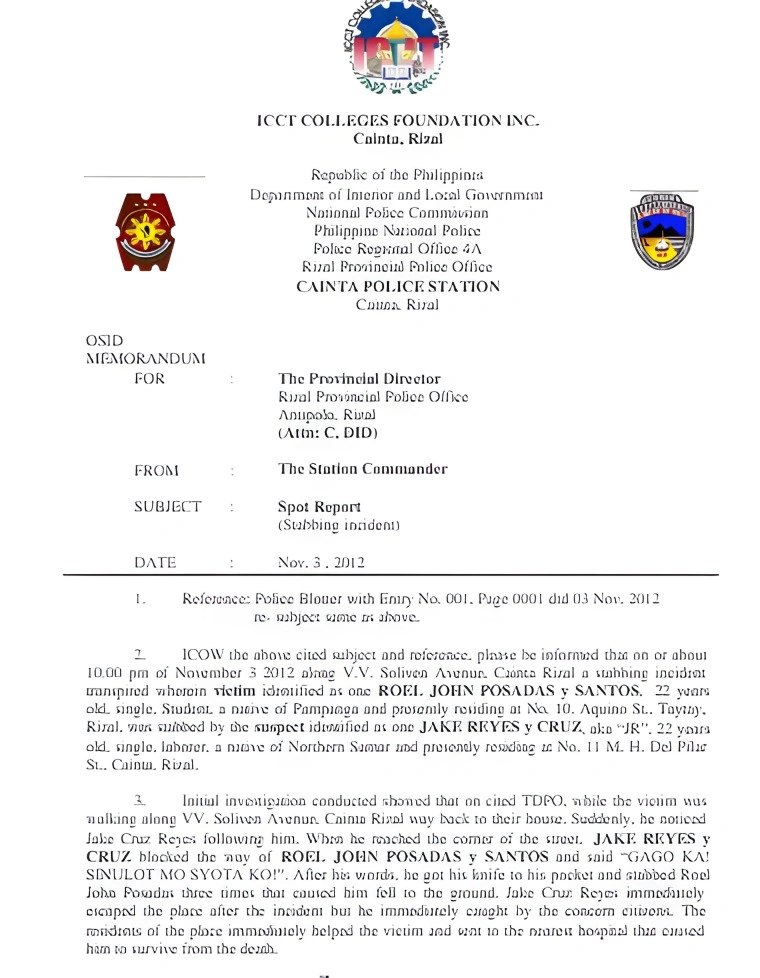
Many applicants encounter guidance suggesting that police clearances are accepted for around three to six months. However, organizations may set their own document-age requirement. A receiving institution may request a newly issued clearance even when an older one has not yet reached its printed expiry date.
Important reminders:
Because police records and reporting systems can change over time, a clearance is generally treated as a time-sensitive document.
Police Clearance vs. NBI Clearance vs. Police Report
These documents are often confused, but they serve different purposes.
| Document | Issuing Authority | Main Purpose | What It Usually Contains |
|---|---|---|---|
| National Police Clearance | Philippine National Police | Police records check for employment, applications, and other transactions | Applicant identity details, clearance result, issuance, and verification information |
| NBI Clearance | National Bureau of Investigation | Separate national-level clearance process | NBI-issued clearance information and its own reference details |
| Police Report or Blotter | Local police station or investigating office | Records a reported incident, complaint, accident, loss, or suspected offense | Incident narrative, parties involved, witnesses, evidence, and officer details |
Police Clearance
A police clearance is commonly requested for:
It is not a narrative account of an incident.
NBI Clearance
An NBI Clearance is different from a PNP police clearance. It is issued through the National Bureau of Investigation and has its own application and verification process.
Some employers, embassies, agencies, or foreign institutions may ask specifically for an NBI Clearance rather than a police clearance. Always submit the exact document requested.
Police Report Sample Philippines
A police report is usually a blotter report, incident report, investigation report, or complaint record. It documents an event that was reported to the police.
A police report does not replace a police clearance.
Police Report Sample Philippines: Format and Details
A police report may contain the following headings and details.
Heading
- Republic of the Philippines
- Department of the Interior and Local Government
- Philippine National Police
- Name of police station
- Station address
- Station number or reference number
Body
- Type of report
- Date and time reported
- Complainant name
- Complainant address
- Contact details
- Respondent or suspect, if known
- Nature of incident
- Narrative of the incident
- Witnesses
- Attached documents or evidence
- Investigating officer name
- Rank and badge number
- Initial findings or recommendations, where applicable
Signatures
A police report may be signed by:
- Complainant
- Investigating officer
- Other required parties, depending on the case
Example Scenario: Theft Report
Type of Report
Blotter Report
Complainant
Maria Santos
Address
123 Rizal Street, Makati City
Contact Number
09123456789
Respondent or Suspect
Unknown person
Nature of Incident
Theft
Narrative of the Incident
The complainant reported that a black mobile phone was missing after she ate at a restaurant on January 3, 2025, at approximately 9:00 AM. The phone was described as Brand X, Model Y, with an IMEI reference recorded by the owner. At the time of reporting, the complainant had no confirmed information identifying a suspect.
Witnesses
None identified at the time of reporting.
Attached Documents
None submitted at the time of the initial report.
Investigating Officer
Police Officer John Cruz, PPO-1234
This is only an example of report structure. Actual police reports must contain accurate information provided in good faith.
Reasons You May Need a Police Clearance
A police clearance can be requested for several legitimate purposes.
Employment
Employers may ask applicants for a police clearance as part of pre-employment screening, especially in roles involving finance, healthcare, education, customer property, security-sensitive work, or public trust.
Visa or Permanent Residency Applications
Some immigration offices, embassies, or foreign authorities may request a police certificate or criminal-record document. Always check whether they require a PNP clearance, NBI Clearance, local police certificate, or another specific document.
Work With Children or Vulnerable Groups
Volunteer programs, schools, care organizations, and social-service roles may request a clearance as part of their safeguarding process.
Professional License or Regulatory Approval
Certain professional, organizational, or government applications may require a police clearance or another background-related document.
Adoption-Related Requirements
An adoption process may require supporting identity and character documents, depending on the responsible authority and case requirements.
Identity Support
A police clearance may sometimes be accepted as a supporting document for identity-related transactions. Acceptance is determined by the agency receiving the application.
Passport-Related Support
The Department of Foreign Affairs determines passport requirements. A police clearance may sometimes be considered supporting identification in limited situations, but it should never be assumed to replace the documents specifically required by the DFA.
Requirements for Getting a National Police Clearance
You cannot legally create your own police clearance by downloading a blank form or editing a template.
The standard process generally involves the following steps.
Create an Online Account
Register through the official National Police Clearance System.
Complete Your Applicant Information
Enter your personal details carefully. Errors in your name, birth information, or address can create delays or mismatches.
Set an Appointment
Choose an available police station, date, and appointment time.
Select a Payment Option
Use only payment options displayed in the official portal during your transaction.
Keep Your Reference and Payment Confirmation
Bring or retain:
- Appointment or reference number
- Payment confirmation or receipt
- Required valid government-issued identification
Visit the Police Station Personally
You may need to appear in person for:
- Identity validation
- Live photo capture
- Fingerprint or biometric capture
- Record-check processing
Wait for Release or Further Instructions
Clearance issuance time can vary. Some applicants may receive a result quickly, while others may need further checking because of a possible name match or data issue.
Do not rely on promises that a clearance will always be released within a specific number of minutes.
Police Clearance Fee and Payment Options
The amount payable and available payment channels can change. Always trust the amount displayed in the official application portal and the payment confirmation generated for your transaction.
Applicants may encounter payment methods such as:
Some guides mention a base police-clearance fee of around ₱150 plus a transaction or convenience charge. Treat this only as a general reference, not a guaranteed current price.
First-Time Jobseekers
Qualified first-time jobseekers may obtain certain government employment documents, including police clearance certificates, without paying fees or charges under the First-Time Jobseekers Assistance Act.
Applicants should prepare the required first-time-jobseeker certification or supporting documents requested by the issuing office.
How to Pay National Police Clearance Through LandBank
The exact payment screens may change, but the safe process is simple:
Never send money to a personal account, unofficial social-media page, fixer, or unverified website claiming to offer police clearance appointments.
Why You Should Not Use a Police Clearance Template
Searches such as “police clearance template,” “police clearance fill-up form,” “police clearance PDF,” or “blank police clearance certificate” can be risky.
A real police clearance is created through the authorized system after identity verification and police processing. A blank form cannot become a valid certificate simply because someone adds a name, image, seal, or QR-like graphic.
Avoid:
Using an altered or fabricated government document can lead to serious legal consequences. The correct solution is always to apply through the official channel.
Frequently Asked Questions
Final words
A Police Clearance Sample Philippines guide is useful for understanding the appearance, format, and purpose of a National Police Clearance, but it is not a substitute for an officially issued document.
A legitimate clearance should be connected to the official application process, personal identity capture, issuing details, and online verification records. For employers and organizations, the most reliable approach is to verify the certificate through the official system rather than relying only on the paper format.
For applicants, avoid templates, unofficial websites, and shortcuts. Register through the authorized National Police Clearance System, attend your appointment personally, and use the clearance only for the purpose for which it was issued.