
Barangay Clearance Online 2026: Fees & Requirements Guide PH
Before you can apply for a job, open a bank account, get a Postal ID, apply for a police clearance, start a small business, or request government assistance, you may be asked for a barangay document. For many Filipinos, this usually means either a barangay clearance or a barangay certificate.
At first, both documents may look simple. You visit your barangay hall, fill out a form, pay a small fee, and wait for your paper. But in real life, many applicants get delayed because they bring the wrong ID, forget their cedula, ask for the wrong document, or assume they can apply at any barangay.
This complete 2026 guide explains barangay clearance requirements, barangay certificate requirements, fees, validity, online application options, sample format, uses, and the difference between a barangay clearance and a barangay certificate. It also includes practical tips so you can prepare properly and avoid wasting time.
What is a Barangay Clearance?
A barangay clearance is an official document issued by the barangay government where you live. It certifies that you are a resident of that barangay, are in good standing in the community, and have no derogatory record, pending case, complaint, or unresolved dispute recorded at the barangay level.
In simple words, it is like a local good moral character certificate from your community. Before national agencies check your background through police clearance or NBI clearance, your barangay first confirms that you have no known local issue within the neighborhood.
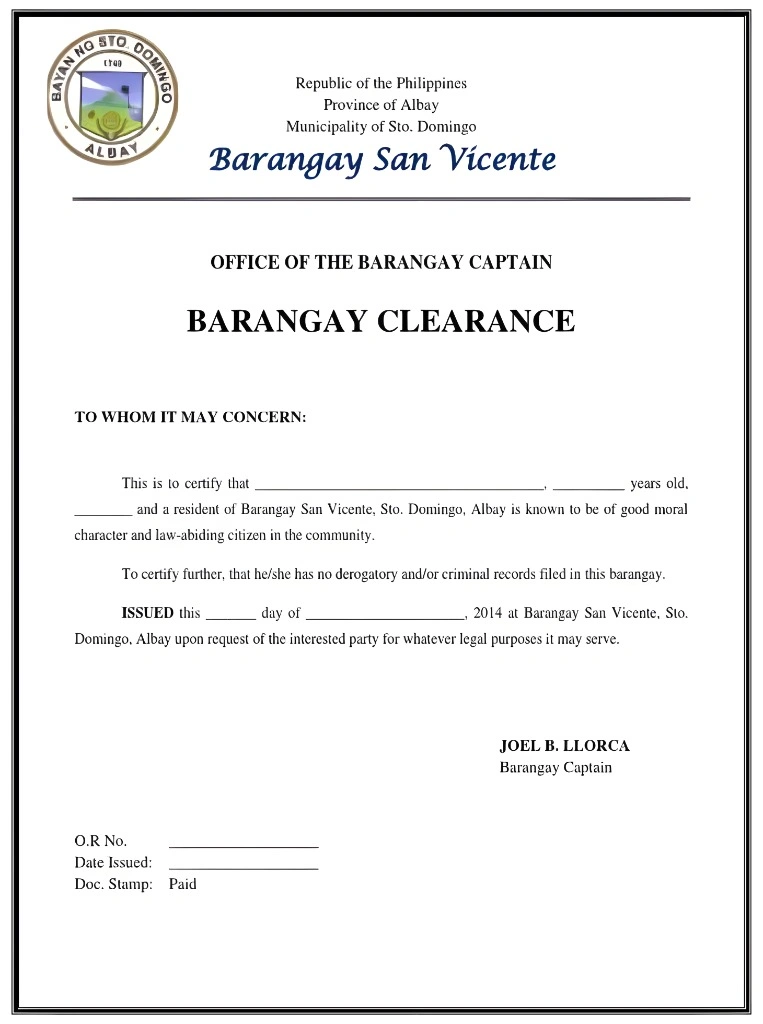
A barangay clearance is usually signed by the Barangay Captain or authorized barangay official and stamped with the barangay seal or dry seal. Without the official signature and seal, the document may not be accepted by offices, employers, banks, or government agencies.
Barangay clearance is commonly required for employment, police clearance, NBI clearance, business permits, loans, marriage license applications, construction permits, and other official transactions.
What is a Barangay Certificate?
A barangay certificate is a general official document issued by the Barangay Captain or barangay office to certify a specific fact about a person, family, business, or activity within the barangay.
The term barangay certificate can refer to different types of documents depending on the purpose. It may certify your residency, indigency, good moral character, business operation, or that the barangay has no objection to a certain request.
This is why many people get confused. A barangay certificate is not always the same document. The wording changes based on what you need it for.
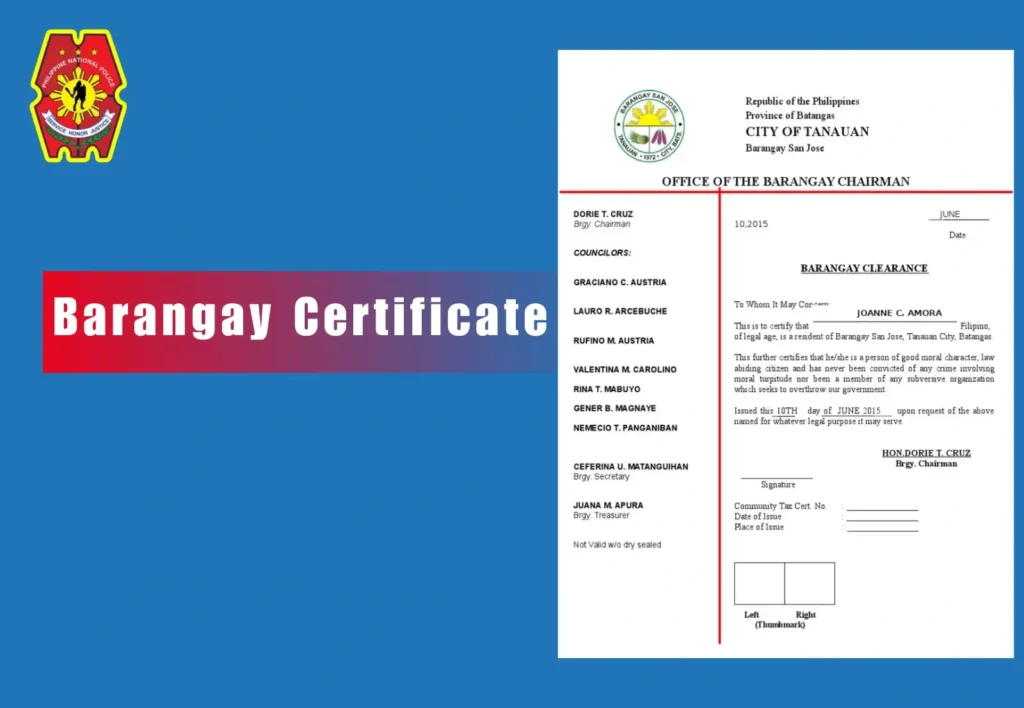
The most common barangay certificates are:
In some places, people may also call it a brgy certificate, barangay clearance certificate, certificate of residency, residence certificate, or certificate of attestation. The exact name may vary, but the purpose is to officially confirm your record, address, income status, character, or business activity within the barangay.
Barangay Clearance vs Barangay Certificate
One of the most common questions is: Is barangay clearance and barangay certificate the same?
The answer is no. They are related, but they are not exactly the same.
A barangay clearance focuses on your character and local record. It confirms that you have no pending complaints, disputes, or derogatory records in your barangay.
A barangay certificate focuses on a specific fact. It may confirm your residency, indigency, business operation, good moral character, or another status depending on what you request.
Barangay Clearance vs Barangay Certificate Comparison
| Document | Main Purpose | What It Proves | Common Uses |
|---|---|---|---|
| Barangay Clearance | Local background and good standing | You are a resident with no pending case or bad record in the barangay | Employment, police clearance, NBI clearance, business permit, marriage license |
| Barangay Certificate of Residency | Proof of address | You live at a specific address within the barangay | Bank account, Postal ID, proof of billing, internet application |
| Barangay Certificate of Indigency | Proof of financial status | You belong to a low-income household or need financial assistance | Scholarship, medical assistance, PAO, social welfare programs |
| Barangay Certificate of Good Moral Character | Proof of good conduct | You are a law-abiding resident with no pending complaints | School admission, job application, legal requirement |
| Barangay Business Clearance or Certificate of Business Operation | Business verification | Your business operates within the barangay and has local approval | Business permit, renewal, closure, Mayor’s Permit |
| Barangay Certificate of No Objection | Local consent | The barangay has no objection to a construction, event, or activity | Construction, relocation, fiesta, concert, property-related requests |
Simple Example
If an employer asks for a barangay clearance, do not submit only a certificate of residency. The employer usually wants proof of good standing and no pending complaints.
If a bank asks for proof of address, a barangay certificate of residency is usually more appropriate than a barangay clearance.
If a scholarship office asks for proof of low income, you need a barangay certificate of indigency.
Main Uses of Barangay Clearance and Barangay Certificate
Barangay documents are often called the prerequisite of prerequisites because you usually need them before applying for other documents or services.
Common Uses of Barangay Clearance
A barangay clearance may be required for:
Job applications
Many companies and government offices ask for barangay clearance before hiring. It helps prove that you are a resident with good moral character and no pending complaints in your barangay.
Police clearance and NBI clearance
A barangay clearance is often requested before applying for police clearance or NBI clearance. It works as a local background check before your national record is reviewed.
Business permits
If you are opening or renewing a business, you may need a barangay business clearance before applying for a Mayor’s Permit. This applies to small businesses such as sari-sari stores, food stalls, online businesses with local operations, and other local establishments.
Bank accounts
Some banks accept barangay clearance as a secondary ID or supporting proof of address, especially if you do not have utility bills under your name.
Postal ID application
Barangay documents are often used when applying for a Postal ID, especially if you need proof of identity or residence.
Loan applications
Banks, cooperatives, micro-lending institutions, and lending companies may ask for barangay clearance to verify your identity, address, and trustworthiness.
Passport or travel-related documents
Some offices may ask for barangay clearance to confirm residency and good standing, especially for first-time applicants or supporting documentation.
Marriage license
Local civil registrars may require barangay clearance for one or both partners before issuing a marriage license. This helps confirm local status and possible disputes.
Construction permits
If you are building or renovating a property, your barangay may require clearance to confirm that the project follows local rules and has no pending objection.
Vehicle registration
Some local offices may ask for barangay clearance as supporting proof of address and identity when processing vehicle-related documents.
Common Uses of Barangay Certificate
A barangay certificate may be required for:
Types of Barangay Certificates
Different agencies require different barangay certificates. Knowing the correct type helps you avoid rejection and repeat visits.
1. Barangay Certificate of Residency
A barangay certificate of residency confirms that you live within a specific barangay. It is one of the most commonly requested barangay certificates.
Purpose:
Best for:
Sample wording:
“This is to certify that Mr./Ms. Juan Dela Cruz is a bonafide resident of Barangay 123.”
2. Barangay Certificate of Indigency
A barangay certificate of indigency certifies that a person or family belongs to a low-income household or needs financial support.
Purpose:
Best for:
Possible additional process:
3. Barangay Certificate of Good Moral Character
This certificate confirms that you are a law-abiding resident with no pending dispute, complaint, or bad record within the barangay.
Purpose:
Best for:
4. Barangay Certificate of Business Operation
A barangay certificate of business operation verifies that a business exists and operates within the barangay.
Purpose:
Best for:
5. Barangay Certificate of No Objection
A barangay certificate of no objection states that the barangay has no objection to a certain activity, construction, event, relocation, or property-related request.
Purpose:
Best for:
Barangay Clearance Requirements 2026
Barangay clearance requirements may vary slightly depending on your city, municipality, or barangay. However, most barangays ask for the following documents.
1. Valid ID
You need to prove your identity. Bring at least one original valid ID and, if possible, a photocopy.
Accepted IDs may include:
Student exception:
2. Proof of Residency
Some barangays ask for proof that you actually live within their jurisdiction, especially if you are a tenant, newcomer, or your ID address does not match your current residence.
Accepted proof may include:
New residents:
- If you recently moved to the barangay, especially within the last six months, the barangay may ask for a certificate of transfer, endorsement from your previous barangay, lease contract, or additional proof of residence.
3. Community Tax Certificate or Cedula
The cedula is one of the most commonly missed requirements. Many barangays will not issue a barangay clearance unless you present a current year’s Community Tax Certificate.
Where to get it:
Estimated cost:
Tip:
- Bring extra cash and ask if you can buy your cedula at the same barangay hall before applying for the clearance.
4. Filled-Out Application Form
The application form is usually available at the barangay hall. You must provide accurate personal details, address, and purpose of the clearance.
Common details requested:
Important:
5. Barangay Clearance Fee
Most barangays charge a small processing fee. Always keep the official receipt because it serves as proof of payment.
6. Additional Requirements for Special Purposes
Depending on your purpose, the barangay may request additional documents.
For business clearance:
For construction:
For first-time job seekers:
Barangay Certificate Requirements 2026
Barangay certificate requirements also depend on the type of certificate you need. The table below summarizes the common documents and why they matter.
| Requirement | Details | Why It Is Needed |
|---|---|---|
| Valid ID | Government-issued ID such as Passport, Driver’s License, National ID, UMID, Voter’s ID, PhilHealth ID, or accepted TIN ID | Confirms your identity and helps match your records |
| School ID | Usually accepted for students without government ID | Helps students apply for school-related or scholarship documents |
| Cedula or Community Tax Certificate | Current year’s cedula, usually valid for one year | Required for many local government transactions |
| Proof of Residency | Utility bill, lease agreement, HOA certification, barangay billing document, or other proof of address | Confirms that you live within the barangay |
| Application Form | Official form from the barangay office | Records your personal details and purpose |
| Processing Fee | Usually paid in cash at the barangay hall | Covers document processing, depending on local ordinance |
| Barangay ID | Optional in many places | Can support proof of residency |
| Extra Documents | Depends on certificate type, such as proof of income, business registration, or medical request documents | Supports special certificate requests such as indigency or business operation |
Additional Notes for Certificate Applicants
For Certificate of Residency:
For Certificate of Indigency:
For Certificate of Business Operation:
For Certificate of No Objection:
How to Get Barangay Clearance in the Philippines
The walk-in process is usually simple if your documents are complete.
Step 1: Go to Your Local Barangay Hall
You cannot apply at just any barangay. You must go to the barangay that covers your current residence.
Common question:
Can I get barangay clearance anywhere?
No. You can only get it from the barangay where you officially reside or where your address is under its jurisdiction.
Step 2: Request a Barangay Clearance Application Form
Step 3: Submit Your Requirements
Submit the completed application form together with your:
If you do not have a cedula, ask if you can get one at the barangay hall or nearby city or municipal office.
Step 4: Pay the Barangay Clearance Fee
Proceed to the treasurer, cashier, or designated payment counter.
After paying, ask for an official receipt. This is your proof of payment.
Step 5: Wait for Processing and Record Checking
The barangay staff may check the logbook, blotter records, or complaint records to confirm that you have no pending dispute, complaint, or unresolved case.
In some modern barangays, especially in cities, you may also be asked for:
Processing may take a few minutes if records are clear and the signing official is available.
Step 6: Claim Your Barangay Clearance
If your record is clean, your clearance may be released on the same day.
Before leaving, check:
If there is a typo, ask for correction immediately before using the document.
What Happens If You Have a Pending Barangay Record?
If you have an unresolved barangay dispute, complaint, or blotter record, the barangay may hold your clearance until the issue is settled.
Examples may include:
In this situation, you may need to appear before the Lupon or settle the issue before the clearance is released.
How to Get a Barangay Certificate
The barangay certificate process is similar to barangay clearance, but the most important part is choosing the correct certificate type.
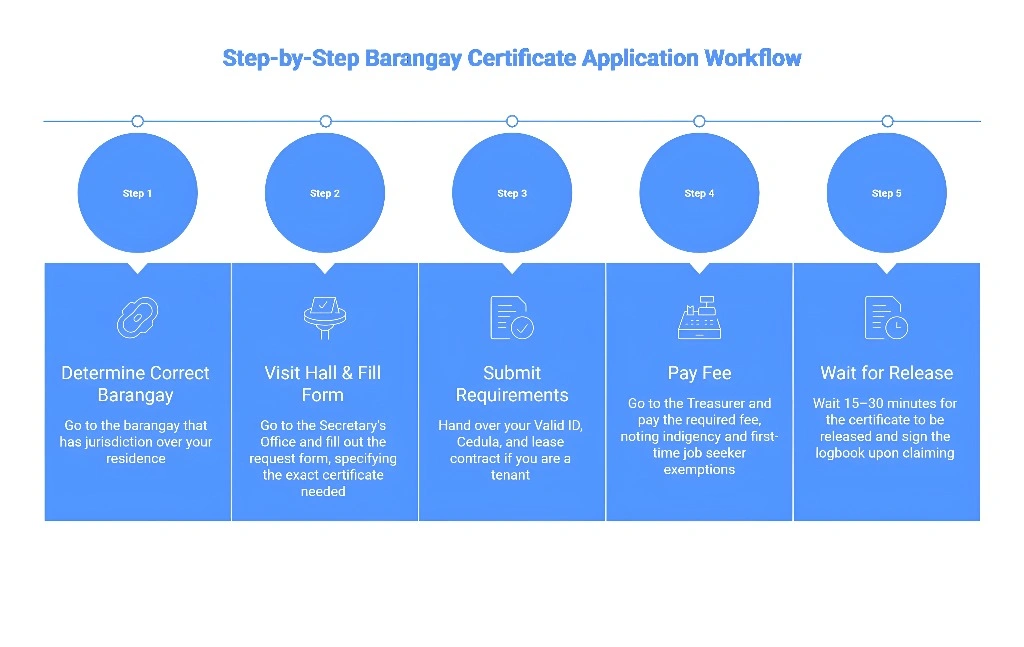
Step 1: Determine the Correct Barangay
Visit the barangay hall that has jurisdiction over your residence or business location.
You cannot get a valid barangay certificate from a barangay where you do not live or where your business is not located.
Step 2: Visit the Barangay Hall During Office Hours
Most barangay halls operate from around 8:00 a.m. to 5:00 p.m., Monday to Friday. Some barangays may also offer limited services on Saturdays or during special schedules.
Going early is better because the Barangay Captain or authorized signatory is more likely to be available.
Step 3: Request the Correct Certificate
Tell the staff exactly what you need. Do not just say “certificate.”
Say the specific type:
Important:
Step 4: Fill Out the Request Form
Provide accurate information and write your purpose clearly. The wording on the certificate may depend on the purpose you write.
Step 5: Submit Requirements
Submit your valid ID, cedula, proof of residency, and any additional documents required for your certificate type.
Step 6: Pay the Fee
Pay the required processing fee at the designated counter. Indigency certificates and first-time job seeker documents may be free depending on the purpose and applicable law.
Step 7: Wait for Verification
The barangay may verify your residency, records, income status, or business location depending on the certificate requested.
Estimated wait time:
Step 8: Claim the Certificate and Sign the Logbook
When the certificate is ready, you may be asked to sign the release logbook before receiving the document.
Before leaving, check:
How to Apply for Barangay Clearance Online
Many people search for barangay clearance online or online barangay clearance registration. Online application is possible in some cities, but it is not available everywhere.
Is There a National Barangay Clearance Website?
No. There is no single centralized national website for barangay clearance in the Philippines. Barangays are local government units, and each city, municipality, or barangay may have its own process.
Unlike NBI clearance or police clearance, barangay clearance is handled locally.
Cities and Systems That May Offer Online Barangay Services
Some progressive cities offer online portals or apps for barangay-related requests.
Examples include:
Availability may change depending on the local government unit, barangay participation, and type of document.
Usual Online Barangay Clearance Steps
If your barangay or city offers online application, the process may include:
Common Online Payment Options
Depending on the local system, accepted payment methods may include:
Important Online Safety Reminder
Only use official government websites, verified city portals, official barangay pages, or confirmed eBarangay systems. Avoid sending personal documents through random social media accounts, unofficial pages, or people claiming they can process your clearance for an extra fee.
If you live in a province, rural area, or barangay without online services, assume that walk-in application is still required unless your barangay officially announces otherwise.
Online Barangay Certificate and eBarangay Services
Some barangays now allow online appointment booking, pre-registration, or request forms for barangay certificates. This can help reduce waiting time, but it does not always mean the entire process is online.
Possible online options include:
Documents that may be available online:
Even if you apply online, some barangays may still require personal appearance for verification, signature, thumbprint, or claiming of the document.
Barangay Clearance Fees
Barangay clearance fees are usually affordable, but they vary depending on the barangay, city, municipality, purpose, and local ordinances.
Common Fee Range:
| Purpose | Estimated Fee |
|---|---|
| Personal use | ₱20 to ₱100 |
| Employment | Around ₱50 in many barangays |
| General clearance | ₱50 to ₱100 |
| Business clearance | ₱200 to ₱1,000 depending on business size and local rules |
| Some barangays | Up to around ₱200 depending on location and purpose |
| First-time job seeker | Free under RA 11261, with required Oath of Undertaking |
Factors That Affect Barangay Clearance Fee
Purpose
A clearance for personal use or employment may cost less. A barangay business clearance may cost more because it is connected to business permits.
Location
Fees may differ between urban and rural barangays. City barangays may charge differently based on local ordinances.
Business size
For business clearances, the fee may depend on the business type, size, location, or declared activity.
Cedula cost
The cedula is usually paid separately. Its cost may depend on income and local government rules.
Reminder:
Always ask for an official receipt after payment. Avoid fixers or unofficial payments.
Barangay Certificate Fees
Barangay certificate fees are also generally low and may vary depending on the certificate type.
Common Certificate Fee Range:
| Certificate Type | Estimated Fee |
|---|---|
| Certificate of Residency | ₱20 to ₱100 |
| Certificate of Good Moral Character | ₱20 to ₱100 |
| General barangay certificate | ₱50 to ₱100 |
| Certificate of Indigency | Usually free |
| First Time Job Seeker Certificate | Free with Oath of Undertaking |
| Special certificate with additional verification | May cost up to ₱150 or more depending on local rules |
Some barangays may charge around ₱20 to ₱150 depending on the document type and purpose. If notarization or special verification is required, fees may be higher.
Bring small bills because barangay offices may have limited change.
Validity of Barangay Clearance and Barangay Certificate
Barangay documents are valid only for a limited period. Always check the date of issue and the expiry date if printed.
Barangay Clearance Validity
A barangay clearance is commonly valid for:
- Six months
- One year
- Three to six months for institutions that require recent documents
Some barangays print an expiry date at the bottom of the clearance. Others only print the date issued.
Important:
- Some offices treat barangay clearance as valid for one transaction only.
- A job application may require a fresh clearance.
- A police clearance application may require a recent barangay clearance.
- A business permit office may require a clearance issued within a specific period.
Barangay Certificate Validity
A barangay certificate is commonly valid for:
- Six months from the date of issue
- Three months if required by banks, DFA-related transactions, employers, or specific agencies
- One transaction only for indigency or special-purpose certificates
A Certificate of Indigency is often valid only for the specific transaction stated in the document.
Can You Use an Old Barangay Certificate?
No. You should not use an outdated barangay certificate for a new application. For example, a certificate issued in 2023 will not normally be accepted for a 2026 application.
When in doubt, ask the agency receiving the document how recent it must be.
Barangay Certificate Sample and Format
Knowing the barangay certificate format helps you check if your document is complete and valid.
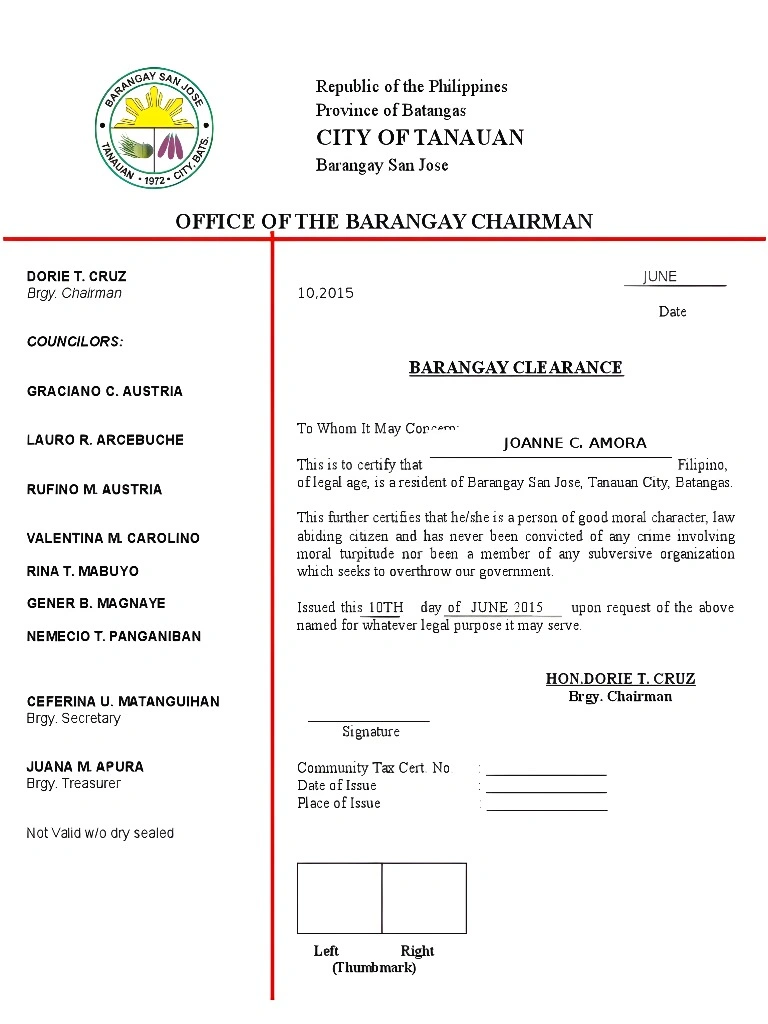
Standard Barangay Certificate Format
| Section | Details |
|---|---|
| Header | Republic of the Philippines, Province or City/Municipality, Barangay Name, Office of the Punong Barangay |
| Salutation | “TO WHOM IT MAY CONCERN:” |
| Certification Body | Statement confirming the person’s name, age, civil status, address, residency, good standing, or specific status |
| Purpose Clause | States why the certificate is issued, such as banking, school, employment, scholarship, ID requirement, or legal purpose |
| Date Issued | Date when the certificate was prepared and released |
| Signature | Signature and printed name of the Barangay Captain or authorized official |
| Seal | Barangay seal, dry seal, or official stamp |
Sample Barangay Certificate Wording
TO WHOM IT MAY CONCERN:
This is to certify that [Full Name], of legal age, [Civil Status], and a resident of [Complete Address], is a bonafide resident of this barangay.
Based on barangay records, the above-named person has no pending case, complaint, or violation filed before this office and is known to be of good moral character.
This certification is issued upon the request of the interested party for [Purpose].
Issued this [Date] at Barangay [Name], [City/Municipality], Philippines.
Barangay Seal or Dry Stamp
Pro Tip:
Check the spelling of your name before leaving. If there is a typo in your name, address, purpose, or date, ask the staff to reprint the certificate before the Barangay Captain signs it or before you submit it to another office.
What’s Inside a Barangay Clearance Document
A barangay clearance usually contains several important details. These details prove that the document is official and useful for verification.
Barangay Name and Seal
The official name of the barangay, city, municipality, and sometimes province appears at the top. The barangay seal or dry seal confirms authenticity.
Applicant’s Personal Information
This may include:
- Full name
- Address
- Age
- Civil status
- Other identifying details
Certification Statement
This statement confirms that the applicant is a resident in good standing and has no pending case, complaint, dispute, or derogatory record in the barangay.
Purpose of Issuance
The document usually states the purpose, such as employment, police clearance, business permit, loan application, school requirement, or ID application.
Barangay Captain’s Signature
The signature of the Barangay Captain, Barangay Chairman, or authorized official is required to make the document valid.
Date Issued and Validity
The date issued is printed on the document. Some clearances also include an expiry date or validity period.
Official Receipt Reference
Some barangays may include receipt details or require you to keep the official receipt separately.
Getting a Barangay ID Using Barangay Clearance
Many people apply for barangay clearance because they also want to get a Barangay ID.
What is a Barangay ID?
A Barangay ID is an identification card issued by the barangay. It can be useful for people who do not yet have many government IDs.
Why Get a Barangay ID?
A Barangay ID may help with:
- Local transactions
- SIM card registration in some cases
- Minor verification needs
- Proof of residency within the barangay
- Supporting document when applying for other IDs
Basic Process
- Apply for barangay clearance or residency certificate.
- Ask if you can apply for or upgrade to a Barangay ID.
- Submit photo, ID, and other required details if needed.
- Pay the additional fee if applicable.
- Wait for printing or lamination.
Estimated additional fee:
- Around ₱50 to ₱100 in many barangays
Important:
A Barangay ID may be accepted for minor transactions, but major banks and national agencies may not treat it as a primary ID. Always ask the receiving office first.
First Time Job Seeker Free Barangay Documents
Under Republic Act No. 11261, also known as the First Time Jobseekers Assistance Act, qualified first-time job seekers may get certain government documents for free, including barangay clearance or barangay certification.
Who Can Benefit?
This applies to qualified first-time job seekers who are applying for employment for the first time.
Barangay Documents That May Be Free
- Barangay Clearance
- Barangay Certificate for First Time Job Seeker
- Supporting barangay certification needed for free police clearance or NBI clearance
What You May Need
- Valid ID
- Proof of residency
- Oath of Undertaking
- Barangay certification that you are a first-time job seeker
Benefit
Your free barangay document can help you apply for other free employment-related documents, such as police clearance and NBI clearance, depending on the rules and requirements of the issuing agency.
Warning
This privilege can only be used once. Do not waste it on the wrong transaction. Ask the barangay staff how to use the First Time Job Seeker benefit correctly.
The Cedula Requirement Explained
The cedula, or Community Tax Certificate, is one of the most common reasons applicants are delayed.
Many applicants bring their ID and money but forget the cedula. When the barangay staff asks for it, they need to line up at another counter or visit city hall or municipal hall first.
What is a Cedula?
This applies to qualified first-time job seekers who are applying for A cedula is a Community Tax Certificate used in many local government transactions. It helps confirm identity and tax-related local registration. for the first time.
Is Cedula Required for Barangay Clearance?
In many barangays, yes. Some offices may not release a barangay clearance or barangay certificate without a current year’s cedula.
Where Can You Get a Cedula?
You may get a cedula from:
- Barangay Hall
- City Hall
- Municipal Hall
How Much is a Cedula?
For many applicants, it may cost around ₱20 to ₱50, but the amount can vary depending on income and local assessment rules.
Cedula Tips
- Always assume you need a cedula.
- Bring extra cash.
- Ask if the barangay can issue the cedula on the same visit.
- Keep your cedula safe because you may need it for other government forms.
- Check if your cedula is valid for the current year before applying.
Tips for a Smooth Application
A few simple steps can help you finish your application faster.
Before Visiting the Barangay Hall
- Prepare all documents early.
- Bring your valid ID, proof of residence, cedula, and supporting documents.
- Keep photocopies of your ID and other papers.
- Bring small bills for payment.
- Check your cedula’s validity.
- Confirm the barangay’s office hours.
- Visit in the morning or during non-peak hours.
During the Application
- Ask for the exact document you need.
- Fill out the form clearly and honestly.
- Make sure your details match your ID.
- Pay only at the official cashier or treasurer.
- Ask for an official receipt.
- Avoid fixers.
- Be polite and patient with staff.
Before Leaving
- Check spelling of your name.
- Check address and purpose.
- Confirm the date issued.
- Make sure the document has a signature.
- Make sure the barangay seal or dry stamp is present.
- Keep extra copies for future reference.
Dress Code Reminder
Some barangay offices may be strict about proper clothing. Avoid wearing slippers, sleeveless shirts, or inappropriate clothes when applying. Dressing properly helps prevent unnecessary issues.
Common Problems and Quick Solutions
Problem 1: You Asked for the Wrong Document
Solution:
Ask the receiving agency what exact document they need. If they need proof of address, request Certificate of Residency. If they need proof of good standing, request Barangay Clearance.
Problem 2: You Forgot Your Cedula
Solution:
Ask if you can get a cedula at the barangay hall. If not, go to city hall or municipal hall and return with the current year’s cedula.
Problem 3: Your ID Address Does Not Match Your Current Address
Solution:
Bring a lease contract, utility bill, HOA certification, or other proof that you live in the barangay.
Problem 4: You Recently Moved to the Barangay
Solution:
Ask if they require a certificate of transfer, previous barangay endorsement, lease contract, or minimum residency period.
Problem 5: Your Name is Misspelled on the Certificate
Solution:
Request correction immediately before leaving the barangay hall. Do not submit a document with incorrect spelling.
Problem 6: The Barangay Captain is Not Available
Solution:
Ask if an authorized officer can sign the document or return during the time when the signing official is available.
Problem 7: You Have a Pending Barangay Complaint
Solution:
Settle the issue through the barangay process or appear before the Lupon if required. The clearance may be delayed until the complaint is resolved.
Problem 8: Someone Offers Faster Processing for Extra Money
Solution:
Avoid fixers. Deal only with official barangay staff and pay only at the authorized payment counter.
History and Purpose of Barangay Clearance
The barangay clearance system comes from the idea that the smallest local community should be able to verify its residents. Historically, local leaders in villages or barrios were expected to know and vouch for the people living in their area.
Today, barangay clearance still serves that purpose. It allows the barangay to confirm that a person is part of the community and has no recorded local issue before that person applies for larger government documents or official transactions.
It also supports the barangay justice system. If a person has an unresolved community dispute, the barangay may require settlement before issuing a clearance. In this way, the document helps encourage local accountability and peaceful resolution of neighborhood issues.
Frequently Asked Questions
Final words
Barangay clearance and barangay certificate are essential local documents in the Philippines, often needed for jobs, bank accounts, IDs, police or NBI clearance, business permits, scholarships, and assistance programs. The key is to request the right document: choose a Certificate of Residency for proof of address, Barangay Clearance for good standing, and Certificate of Indigency for financial aid.
To avoid delays, bring a valid ID, cedula, proof of residency, required fee, and supporting documents. Always check if your barangay offers online registration, visit early, avoid fixers, and review all details before leaving. With proper preparation, you can usually complete the process quickly and smoothly.