
Required Documents for Police Clearance in Philippines 2026!
Getting a police clearance in the Philippines is usually straightforward. However, applicants can face delays when they bring incomplete documents, use expired identification, enter inconsistent personal details, or visit a station without completing the required online steps.
A police clearance may be required when applying for a job, passport, government identification, business registration, professional license, bank account, scholarship, internship, visa, immigration process, or overseas employment. It may also be requested for education, personal records, legal proceedings, and other official transactions.
This guide explains the police clearance documents required in the Philippines. It covers National Police Clearance applications, local walk-in applications, renewals, students, minors, first-time jobseekers, persons with disabilities, foreign nationals, and applicants using the document abroad.
Always use the official Philippine National Police National Police Clearance System portal. Avoid websites that imitate the official portal or ask for unnecessary personal information.
Quick Police Clearance Documents Checklist
Most National Police Clearance applicants should prepare the following:
Depending on the applicant, station, location, or purpose, the following may also be requested:
Understanding Police Clearance
A police clearance, also called a police clearance certificate, is an official document issued by the Philippine National Police or an authorized police clearance center.
It reports whether the applicant has matching criminal or derogatory information in the police database at the time of checking. It may also confirm that no matching record was found.
The National Police Clearance System, commonly called NPCS, uses a centralized database. This allows participating police stations to conduct a broader identity and record check than an older clearance limited only to one locality.
A police clearance does not guarantee a person’s character or future behavior. It only reports the result of the police database check conducted during the application.
Who Needs a Police Clearance?
Police clearance may be requested from the following applicants:
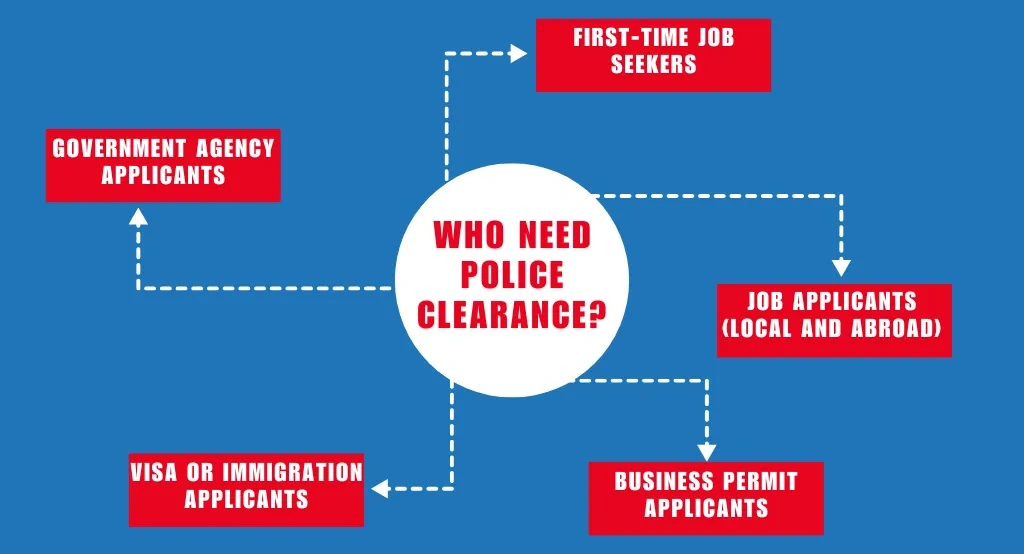
Job Applicants
Private companies and government employers may request police clearance during recruitment or background verification.
Students
Students may need it for:
- Internships
- Scholarships
- On-the-job training
- Part-time employment
- School applications
- Exchange programs
- Other academic requirements
Visa and Immigration Applicants
Some embassies, immigration authorities, employers, or overseas agencies may request a police certificate as evidence of background history.
Applicants must confirm whether the receiving organization wants:
- National Police Clearance
- Local Police Clearance
- NBI Clearance
- Apostilled document
- Another type of criminal-record certificate
For many international applications, an NBI Clearance may be preferred instead of a PNP Police Clearance.
Business Owners and Professionals
Police clearance may be required for:
- Business permits
- DTI-related transactions
- Professional licenses
- Local government registrations
- Security-related work
Individuals Completing Personal or Legal Transactions
It may also be needed for:
- Court proceedings
- Personal documentation
- Adoption-related requirements
- Government identification applications
- Banking requirements
- Travel documentation
- Other official transactions
National Police Clearance vs Local Police Clearance
The requirements can differ depending on whether you need a National Police Clearance or a Local Police Clearance.
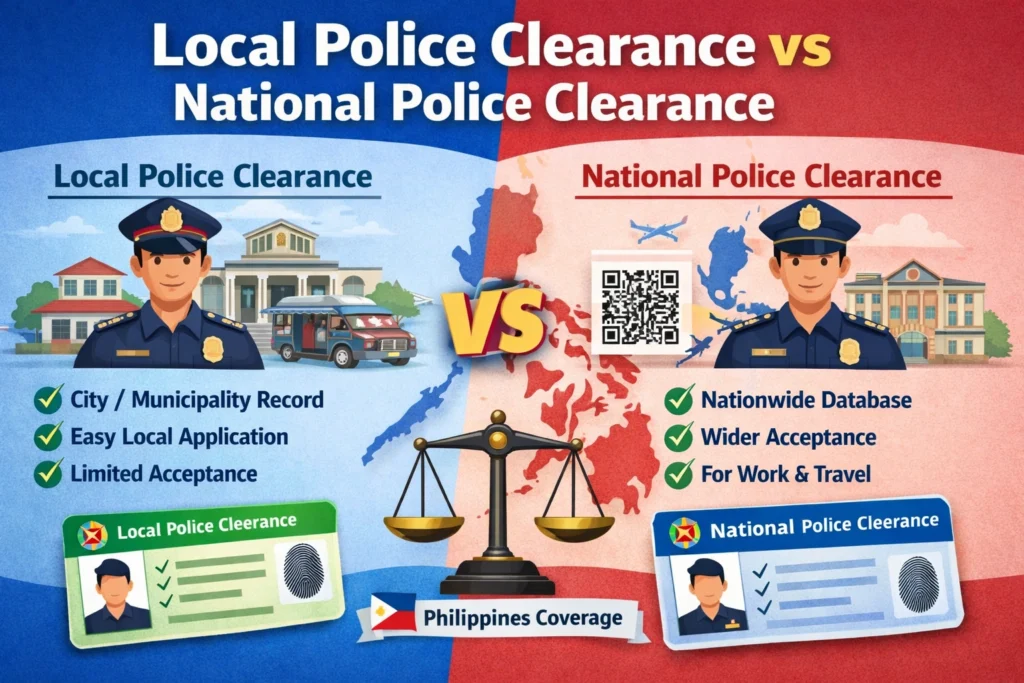
| Requirement or feature | National Police Clearance | Local Police Clearance |
|---|---|---|
| Application method | Usually begins through the NPCS portal | May be processed directly at a local station |
| Database coverage | Uses the National Police Clearance System | May focus on local records and residency |
| Online account | Usually required | May not be required |
| Appointment | Usually booked online | Depends on the station |
| Reference number | Required | May not be required |
| Two valid IDs | Recommended and commonly required | Commonly required |
| Barangay Clearance | Usually not a standard requirement, except in special cases | Frequently required |
| Cedula | Usually not required for NPCS processing | Frequently requested |
| Payment | Through available online channels | Online or at the station, depending on local rules |
| Biometrics | Completed at the station | Completed if required by the local station |
| Paper form | Usually generated from the online profile | May be completed manually |
Requirements can vary by municipality. Contact the selected police station before visiting if you need a Local Police Clearance.
Complete List of Required Documents for Police Clearance
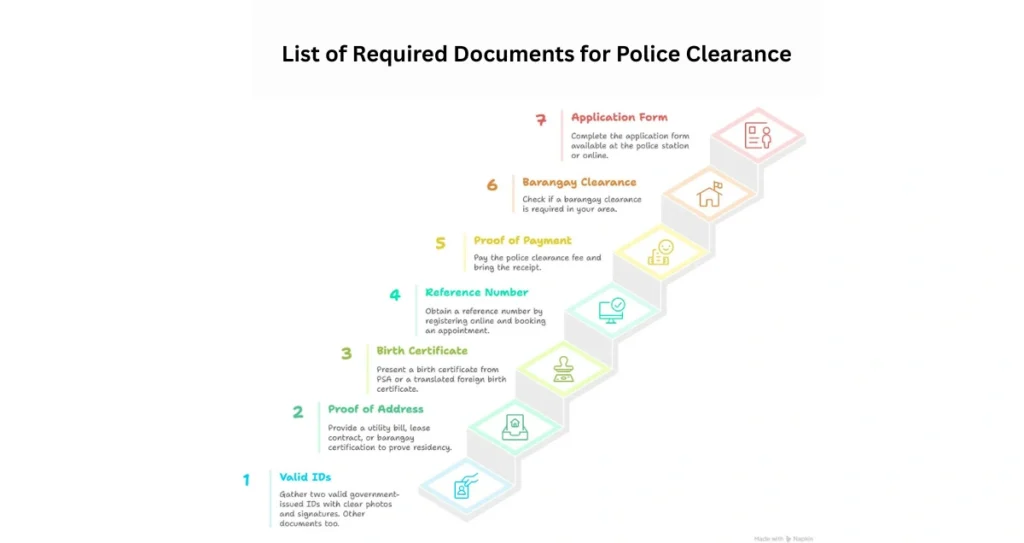
1. Valid Government-Issued IDs
Identification is the most important requirement. Applicants should bring two different original government-issued IDs whenever possible.
Although some PNP instructions may refer to one valid ID, other official materials and many stations require two. Bringing two originals reduces the chance of being refused or asked to return.
Each ID should:
Bring photocopies as backups, but do not rely on photocopies as your primary identification.
2. Proof of Address
Proof of address confirms where the applicant currently lives.
Depending on the station, acceptable documents may include:
The document should show the applicant’s current address. When a utility bill is not in the applicant’s name, the station may request an additional residency document.
Proof of address is not always required for a standard NPCS application. It is more commonly requested for local clearance applications, foreign residents, minors, or applicants whose current address needs verification.
3. PSA Birth Certificate
A birth certificate may be requested to confirm:
Filipino applicants should preferably bring a birth certificate issued by the Philippine Statistics Authority.
Older NSO-issued copies may still be accepted in some transactions, but a current PSA-issued copy is the safer option.
Foreign applicants may be asked for a birth certificate issued by their home country. A certified English translation may be required when the document is written in another language.
A birth certificate normally supports identification. It may not replace the required photo ID unless the station specifically allows it.
4. Police Clearance Application Reference Number
Applicants using the NPCS portal receive a reference number after completing the required online steps.
The reference number is used for:
Save the reference number in several forms:
5. Proof of Payment
Applicants must present proof that the clearance fee has been paid.
Acceptable proof may include:
The officer may check the payment status before beginning biometrics or releasing the clearance.
6. Barangay Clearance or Certificate of Residency
A Barangay Clearance is generally not one of the basic documents for an ordinary National Police Clearance application.
However, it may be required when:
- Applying for a Local Police Clearance
- Claiming the first-time jobseeker fee exemption
- Confirming local residency
- Applying without sufficient address documents
- Processing a minor’s application
- Following a station-specific requirement
A Certificate of Residency should normally be recently issued. Some offices may request a document issued within the previous six months.
7. Community Tax Certificate or Cedula
A Community Tax Certificate, commonly called a Cedula, may be required for Local Police Clearance applications.
It can usually be obtained from:
A Cedula is normally not part of the standard NPCS online requirements. However, local police stations may still request it.
8. Recent Passport-Sized Photograph
The police station normally captures the applicant’s photograph during biometrics. However, some local stations may request a printed photograph.
When requested, prepare a recent colored photograph with the following specifications:
Some local stations may request a 1×1 photograph instead. Confirm the exact size before visiting.
9. Police Clearance Application Form
An application form records the applicant’s personal and contact information.
It may request:
The form is completed differently for online and walk-in applications.
Complete List of Accepted IDs for Police Clearance
Not every membership card, company card, or personal document qualifies as a valid government-issued ID.
Applicants should use the strongest identification available.
Primary or Preferred IDs
Commonly presented primary IDs include:
The Digital National ID may be accessed through the eGovPH application. Applicants should still bring another physical ID because station acceptance procedures may vary.
Some guides refer to newer SSS-issued card formats. Applicants should confirm that their specific card is included in the station’s current accepted-ID list.
Secondary or Alternative IDs
Depending on station policy, alternative identification may include:
A school ID may need to be accompanied by:
Other Supporting Identification Documents
The following may support an application but should not automatically be treated as substitutes for the required government IDs:
Important ID Rules
Before the appointment, confirm that:
A minor difference such as “Ma.” on one document and “Maria” on another can cause an identity-verification problem.
A profile mismatch does not automatically mean the application has a criminal-record HIT. However, the officer may need additional documents before confirming the applicant’s identity.
What If You Have Only One Valid ID?
Most applicants should bring two valid IDs.
If you only have one strong government-issued ID, prepare additional supporting documents such as:
Call the selected station before your appointment. Acceptance of supporting documents can differ between stations.
Do not assume that a birth certificate or barangay certificate will always replace a second valid ID.
Requirements for Police Clearance Online Application
Applicants using the NPCS portal generally need the following information during registration:
The information must match the documents you will present at the police station.
After registration, the applicant will normally:
Requirements for Police Clearance Walk-In Applications
A person may still need to appear at the station even after completing an online application. Personal appearance is necessary for document checking, photograph capture, fingerprints, and other biometrics.
For a standard appointment-day visit, prepare:
For a Local Police Clearance processed without the NPCS portal, prepare:
Walk-in availability depends on the station. Some stations may refuse an applicant without an online appointment.
Online vs Walk-In Police Clearance Process
| Step | Online or NPCS applicant | Local walk-in applicant |
| Create an account | Yes | Usually no |
| Enter personal information | Online | Paper form |
| Select police station | Online | Applicant visits local station |
| Book appointment | Usually required | Depends on station |
| Pay clearance fee | Through available payment channel | Online or cash, depending on station |
| Receive reference number | Yes | Usually no |
| Bring printed reference number | Recommended | Usually not applicable |
| Fill out form manually | Usually no | Usually yes |
| Visit police station | Yes | Yes |
| Submit IDs | Yes | Yes |
| Complete fingerprints or biometrics | Yes | When required |
| Complete official photo capture | Yes | When required |
| Wait for record verification | Yes | Yes |
| Receive clearance | After approval | After approval |
Police Clearance Fee and Payment Methods
The standard National Police Clearance base fee is ₱150.
A convenience or service fee may be added by the selected payment provider. The final total may therefore be higher than ₱150.
Applicants commonly report totals of approximately ₱160 to ₱180, but the actual amount depends on the payment channel displayed in the official portal.
Available payment methods may include:
Local stations may accept cash for a Local Police Clearance, depending on municipal procedures.
Always:
Fees and payment methods can change. Follow the amount and options shown in the official portal during your application.
Police Clearance Application Form
Applicants using the NPCS portal do not normally need to complete a separate handwritten form.
The digital form is created from the information entered when the applicant:
- Creates an account
- Completes the profile
- Selects a police station
- Books an appointment
- Generates the payment reference
- Pays the clearance fee
The selected station can access the submitted information using the reference number.
In rural areas or local stations using a separate clearance procedure, the applicant may be required to complete a paper form.
Complete the form carefully and use the same spelling shown on your identification documents.
Do not use nicknames unless the form specifically asks for them.
Requirements for First-Time Jobseekers
Qualified first-time jobseekers may claim a fee exemption under Republic Act No. 11261, known as the First-Time Jobseekers Assistance Act.
The applicant should obtain a Barangay Certification confirming that the person:
The barangay may also require the applicant to have lived in the area for a specified period, commonly at least six months under applicable implementation procedures.
The fee exemption is generally available only once for each covered document or transaction.
Bring:
Without the correct barangay certification, the standard clearance fee may apply.
Requirements for Students
Students applying for police clearance should prepare:
A purpose letter may state that the clearance is required for:
Contact an NPCS-linked station before applying because additional requirements may apply to students or applicants under 18.
Requirements for Minors
Applicants below 18 may be permitted to apply when they have a legitimate reason.
Prepare:
The minor should be accompanied by a parent or legal guardian.
The guardian may be required to remain with the minor throughout:
Requirements may differ according to the minor’s age and the reason for applying.
Requirements for PWD Applicants
A person with disability should prepare:
Some stations provide priority seating or assistance during biometrics. Availability depends on the facility.
An applicant who needs accessibility support may contact the station before the appointment.
Police Clearance Requirements for Foreign Nationals
Foreign nationals living, studying, or working in the Philippines may apply when the selected police station offers the service.
Prepare the following:
The purpose letter may state that the clearance is needed for:
All documents should be current and original.
Foreign applicants should contact the station in advance because not every local station follows the same process.
Required Documents for Police Clearance Renewal
A National Police Clearance is commonly valid for six months from its date of issuance.
Once it expires, the applicant normally completes a new application instead of receiving a simple extension of the old document.
For a new application after expiration, prepare:
The old clearance is usually optional. However, it may help officers review a previous identity-verification or HIT issue.
Before booking, update information that has changed, including:
Do not use an old payment receipt or old reference number for a new application.
Required Documents for Overseas Use or Apostille
A standard police clearance may not be the correct document for every foreign transaction.
Many embassies, immigration departments, overseas employers, and visa offices request an NBI Clearance instead of a National or Local Police Clearance.
Before obtaining an apostille, ask the receiving organization:
If the receiving organization accepts an apostilled police clearance, possible supporting documents may include:
The exact authentication route depends on the type of police clearance and the country where it will be used.
Countries and employers may have different requirements. This includes applications connected with Canada, Japan, Dubai or the United Arab Emirates, and other destinations.
Do not pay for an apostille until the embassy, employer, school, or immigration authority confirms that it will accept the PNP document.
Optional but Helpful Documents
These documents are not required from every applicant, but they may help resolve questions:
For Filipino Applicants
For Foreign Applicants
Step-by-Step Police Clearance Online Application
Step 1: Open the Official NPCS Portal
Step 2: Create an Account
Step 3: Verify Your Email
Step 4: Complete Your Profile
Enter your:
Use the same spelling and format shown on your IDs.
Step 5: Select a Police Station
Step 6: Select an Appointment Date and Time
Step 7: Generate the Payment Reference
Step 8: Pay the Clearance Fee
Step 9: Visit the Police Station
Bring:
Step 10: Complete Document Verification
Step 11: Complete Biometrics
You may be required to provide:
Step 12: Wait for Database Checking
Step 13: Receive the Result
Step 14: Verify the Clearance
Steps to Obtain a Local Police Clearance
The exact process varies, but a local walk-in application commonly includes the following:
Some police clearance services may be available at a city hall, municipal hall, specialized center, or mall-based government service location.
What Is a HIT in Police Clearance?
A HIT means the system found a possible match between the applicant’s name or identity information and a record in the police database.
A HIT does not automatically mean the applicant:
A HIT may occur because another person has the same or a similar name.
The police may conduct manual identity verification. The applicant may be instructed to return after several days.
Bring any requested documents that help distinguish your identity, such as:
Spelling mistakes or inconsistent profile details can create document-verification problems, but they are not the same as a criminal-record HIT.
How Long Is Police Clearance Valid?
A National Police Clearance is commonly valid for six months from the issuance date.
Check the date printed on the certificate and count six months forward.
The requesting organization may impose a shorter freshness requirement. For example, an employer or embassy may ask for a clearance issued within the previous three months.
Always follow the requesting organization’s rule even when the certificate has not reached its printed expiration date.
Police Clearance Processing Time
Processing time depends on:
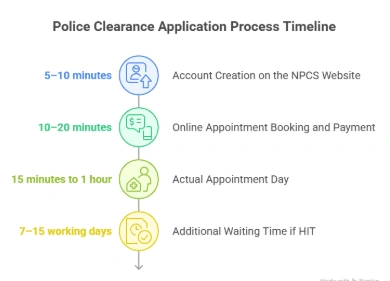
An applicant with complete documents and no HIT may receive the clearance on the appointment day.
Applications requiring manual checking may take several days. Certain local or special applications can take longer.
Older guides may mention processing periods of several days to several weeks or paid expedited services. Do not pay an additional expedited fee unless it is officially posted, properly receipted, and offered by the issuing office.
What to Check Before Visiting the Police Station
Valid Identification
Make sure your IDs:
Application Details
Check your:
Payment
Confirm that:.
Additional Documents
Check whether your case needs:
Tips to Avoid Delays
Follow these precautions before your appointment:
Preparing Originals and Photocopies
Bring original documents for inspection.
Also prepare photocopies because some centers retain copies for their records.
A practical document folder may include:
Photocopies do not normally replace original identification.
What to Do If Your Police Clearance Is Lost
If you lose the document:
If the station cannot reissue the document, you may need to complete a new application.
Contact Details and Police Clearance Support
Use contact information published on the official NPCS portal.
At the time this guide was reviewed, the official portal listed:
Some third-party guides list different telephone numbers, hotline 117, email addresses, or social-media accounts. Confirm that any contact detail is still active before sharing personal information.
For updates, use:
Do not send identity documents to an unverified email or social-media account.
Final Checklist Before Leaving Home
Use this checklist on appointment day:
Frequently Asked Questions
Final words
Preparing the required documents for police clearance is the most important part of the application. Most National Police Clearance applicants should focus on three essential items: valid original IDs, an NPCS reference number, and proof of payment.
Applicants in special categories may need additional documents. These include minors, students, first-time jobseekers, foreign nationals, PWD applicants, local walk-in applicants, and people using the clearance overseas.
Check your IDs, compare your profile information carefully, save your receipt, and confirm station-specific requirements before traveling. Use only the official NPCS and PNP channels, avoid fixers, and never share personal data with an unverified website or account.
With complete documents and no unresolved HIT, many applicants can finish the process in one station visit.